Showing posts with label Patricia West. Show all posts

Sunday, November 25, 2012

Are you gonna eat that?


I notice that a lot of people who write blogs include their own versions of domestic advice, recipes, life skills coaching, and platitudes.  I started writing the Jugular Vein stories on the advice of our long-time friend Betsey Grecoe who suggested that other people might enjoy reading about our family adventures and mishaps.

Now that I have half a century of experience and gathered wisdom, I can join the ranks of those who offer unsolicited advice, snobbish culinary expertise, and household hints for frugality from their poorer days. And I can easily disseminate this wisdom via the internet with my blog! Let's see what I can pull together.


Some of the finest, most fun, and most fulfilling experiences I've had in my life have been in the camaraderie of a kitchen, creating a meal for a crowd, or at the table enjoying a meal with friends and family. The more, the better.  I thought about recounting them here while including recipes, helpful kitchen tips, and proper etiquette reminders, like other blog writers do so successfully. 

These days, on the rare occasions when we're enjoying fine dining, we often find ourselves comparing the experience to past meals and the atmosphere of a little out-of-the way restaurant in rural New Jersey called Duo Fratelli (the Two Brothers).  It was a small restaurant that featured Italian haute cuisine, where the staff outnumbered the guests.  On our first visit – a wedding anniversary dinner – we were greeted and our reservation status was confirmed by the maitre d', who was dressed in black tie service uniform.  We were shown to our table in the dimly lit but spacious room, where the panorama of windows were draped with expensive fabrics offering privacy with taste.  The fresh white linen tablecloths and napkins were smooth and clean, under a full dinner setting of gleaming flatware and glassware.  My chair was held while I sat and my napkin carefully laid in my lap.  The meal that followed was exquisite, the service impeccable, and their recommended wine has become one of our favourites.  Though this was an expensive restaurant, we enjoyed sharing meals there for special people and special occasions.

On one of those visits, we were seated at a rear table far from the entrance.  As we leisurely savoured the many courses of our meal, we noticed the special attention given by the staff to the large round table in the far corner.  Most remarkable was one large dominant man.  He was dressed in an expensive-looking dark suit with gold chains and rings that caught the light.  As each new (and similarly attired) guest arrived and approached the table, he stood to give a large shoulder-forward embrace, ending with a flat-handed slap-slap on each other’s back.  One after another, his guests arrived and were seated until there were approximately ten imposing men gathered.  Each was greeted with the kind of respect usually seen only in a tense episode of The Sopranos.  Wide-eyed with wary observation, we were torn between staying to see a fascinating first-hand glimpse into what appeared to be a mob meeting, and leaving immediately in case tommy-guns suddenly appeared in a gangland shoot-out of epic proportion.  But we couldn't possibly have left, as Duo Fratelli’s crème brûlée dessert is simply the best – it's to die for.


When Kathryn and I took a cross-country road trip and finally landed in Los Angeles, we were eager to shop and see where the rich and famous shop.  To fully appreciate the contrast, we spent a day thrift store shopping in Santa Monica and Venice Beach first. Then we headed to the fabled stores of Wilshire Boulevard and Rodeo Drive.  We dressed up to help ensure we received the full-service treatment (just like the people who actually could afford to be there).  Kathryn, naturally, had a fashionable outfit, and I tried my best not to look too dowdy, and actually brushed my hair.  Since it was hot and sunny, we wore big sunglasses, and I kept on my wide-brimmed straw hat.  Kathryn's trendy sundress, impeccable makeup, and gorgeous looks in general were the perfect attire for the outdoor cafe we visited for a late-day lunch.  If a celebrity passed by, we had a great view and prime photographic opportunity. 

We were quickly seated in a crowded outdoor section of the small café. Shortly after we received our water (with lemon!), a family of four was seated at the table next to us -- just far enough apart for the disinterested wait staff to pass between us.  Staggered by the price points of toast points, we opted for a simple cheese plate with fruit and wine, and amused ourselves with wishful conversation about what we would like to have purchased to augment our wardrobes and jewellery chests.  Brooks Brothers and Harry Winston would have been very happy to accommodate us, but our wallets could not.  At their table next to use, the mother, father, and two adolescent girls chatted amiably, while Kathryn and I finished up. Neither of us removed our sunglasses as we sat under the awnings.

Our waitress, totally indifferent about quality of service though not unpleasant, eventually brought our bill, and I presented a credit card for payment.  When she returned with our receipts and offered a cursory "have a nice day" in mid-retreat, I frowned at Kathryn, who shrugged her shoulder in acknowledgement.  So I replied loudly enough with a bright cheerful sigh of satisfaction for the family sitting next to us to hear, "Well, that was really nice -- just what we needed!" to which Kathryn cheerfully agreed.  I then added, "… and for once, NO paparazzi!"  The two young girls at the next table immediately looked up and around.  So I drove it home with one final comment to Kathryn: "I don't think the waitress even recognized you!" and then we made our way out. All eyes were on Kathryn until we were down to the sidewalk, where I took one last glance back to see the two girls extending themselves over the railing, desperate to see who they'd just missed. 


At home, cooking for our large family was usually routine, but when my folks visited they sometimes seemed overwhelmed with the volume of food, preparations, and portions that four growing teenagers required.  One simple dinner we often made to feed a large crowd was fettuccine that we'd make ourselves.  A bowlful of flour with eggs, water, oil, and salt added in the right proportions can quickly become a homemade pasta; add just about anything to make a complete dinner.

One night, after a long day of visiting, I dug in to prepare a basil pesto and other sauces with some homemade noodles while we waited for Stephen to arrive home from work.  My folks were keen to watch the process, and with two extra guests joining us, I doubled up on the ingredients, and started mixing, kneading, rolling and cutting the noodles right at the kitchen table.  And then the inevitable call came from Stephen mid-transit stuck in a classic New Jersey eight-lane rush-hour traffic jam.

So my folks and I drank more wine while I continued rolling and cutting the dough, and strung the strands up while the sauces simmered and the pasta water boiled.  Since fresh pasta only takes about three minutes to cook, I didn’t want to put it in until Stephen could join us.  My pasta was hanging all around us, on open cupboard doors, the backs of chairs, and over the edge of the table.  When Stephen finally bustled in, we were all famished and eager to start eating, and the ensuing activity in the small kitchen quickly became frenzied as the dog enthusiastically greeted him, steaming bowls of sauces were waltzed about the crowded room to be set out for serving, drinks were poured, and the four kids all came in to take their seats. With all this going on, we didn’t notice that most of the heavy strands of fettuccine had stretched under their own weight, broken off, and fallen onto the floor. 

Our dog Scout noticed it first, and tried to eat as much of it as he could, as quickly and quietly as possible. Stephen noticed it second when he stepped on it and it stuck to his shoes, making him slip and slide on the floor as he tried to get around the dog, who was busy trying to eat all he could get.  It wasn't until I heard "what the hell??" from Stephen that I noticed my long beautiful strands of golden pasta were all gone. Only a few scraps and remnants on top of the doors and chairs were left.  Meanwhile, Dad stood transfixed at the chaotic scene, and my mother was absolutely hysterical with laughter as she watched Stephen hop from foot to foot, grabbing at clumps of pasta dough, and scolding the dog who was being chased around the table by the kids.  Stephen paused, looked around at the whole situation, held up two hands full of dough and said in his best Ricky Ricardo voice, "Luuucy -- you got some 'splaining to do."


When a nephew in central Tennessee was about to get married between Christmas and New Year's Eve, our family of six made the trip from New Jersey to go to the wedding. Unfortunately, our dog Scout had just had a procedure on his eye, and had to wear a large cone around his head. This took up a lot of room in the back of the van, and in the small hotel room where we stayed. 

The wedding was great, and it was nice to reconnect with far-away family and cousins. But it was at a time of the year when we couldn’t really afford such a trip. Stephen was between jobs, so funds were unusually tight, and the credit card was red-hot with transaction friction from the trip, meals, and accommodations.  On the way back home, we stopped at a Wendy's drive-thru for their $1 menu.  We could all get lunch for less than ten dollars!  Poor Scout, who couldn't easily eat and was off his food because of his cone, the stress of travel, and just being out of sorts was especially pitiful.   When we got to the window, we asked the server if they had anything that might have fallen on the floor or was too old to serve that we could give to the dog for a treat, and pointed to the forlorn cone-headed Scout in the back seat.  She said she had nothing, but took pity and gave us a box of chicken nuggets fresh from the fryer. We thanked her sincerely, and headed on our way.  When we got back on the road, we realized there was actually nothing wrong with this free addition to our meal, so we divided the box among ourselves.  They were absolutely delicious. I think we may have given poor Scout just one.


When my dad remarried, he and Anna flew to Slovakia, Anna’s home country, for a honeymoon. On their way there, they stayed with us in New Jersey for a few days. Anna cheerfully put up with our jokes of how backward and primitive Slovakia was (of course we knew differently, but anything for a laugh!) and played along.  One day we walked to a tiny mom & pop shop that featured Polish and Czech ethnic foods, snacks, and videos.  Anna was delighted to find a box of round wafer cookies and brought them home to share.  Apparently, it was a treat she rarely found in Canada, but was a well-known Slovak goodie.  The box was about six inches square and about two inches tall, with bright colors, bold Slovak words, and pictures of happy children anticipating the indulgence and decadence inside.  But the wafers themselves were awful.  The flat cookie was the size of a salad plate, pale and bland in color, and with the texture and taste of a cardboard egg carton.

We ridiculed them mercilessly.  Stephen pantomimed their many potential uses (none as an edible treat) in quick succession – they could be used to play a song, as he cranked a victrola, spinning one on his fingertip and mimicking a jolly tune from the 1800's; he flung one across the room like a Frisbee, announcing its playtime merits in a television-commercial-announcer voice; picked up another, perched it on his upturned fingers, and draped a dishtowel over his arm in full British butler mode, presenting a tray to a Lady.  Then it became the brim of a boater hat while he reminded us of our responsibility to vote for a long-past American president, finally wrapping up his performance by driving himself out of the room using a wafer-cookie steering wheel.  We were convulsed with laughter, and glad Anna took it in equally good humour, laughing along with us. She didn’t take offense, but she did close up the tin and refuse to let us have any more.  She fits right in with us.


As I wrap up this story, I've see that I failed to offer any helpful hints, tasty budget recipes, and certainly no life lessons, but thinking about what has made me personally happy in life, I can offer some unsolicited advice:

"Every day have someone to love, someone who loves you, and something to look forward to."  Allyn S. West II (1953-1988)

Wednesday, January 25, 2012

"Take two and see me in three days"

My folks were tough.  When the three of us children were growing up, we weren't allowed to complain.  Illness and injury received scant sympathy, unless we were in agonizing pain or on our death bed with a serious ailment -- for which eggnog was the typical prescribed remedy.  Injuries were met with "tape it up" and illnesses "just wait 'til the fever subsides." Everything had three-day waiting period before actual medical attention was considered.  Until she was in treatment for lung cancer, my mother never spent a day in bed with a complaint, and no affliction ever kept Dad from his duties until a case of shingles in his seventies.

As parents, Stephen and I tried to be more reasonable; we listened to our children's health concerns, tried to validate and reassure them, and treated them with whatever attention the condition required, whether minor or life threatening.

Our daughter Kathryn has her own special family medical file, however.  An often silent observer and companion to Olivia's frequent hospitalizations, ambulance trips, emergency room visits, and complicated procedures, she became knowledgeable about medical protocol and diagnosis. She developed a kind of hypochondria, announcing the onset of a terminal case of a variety of diseases, requiring immediate attention by a specialist.  We'd insist on the family "three day waiting period," during which a recovery would miraculously occur.

When she left home and took one of her first apartments in the big city, she showed she had a flair for decorating and furnishing tastefully on a limited budget.  When we first visited, we saw her bookshelves neatly filled with both classic and contemporary authors, and DVD sleeves tidily set to one side. Handmade pottery and artwork was displayed with throw pillows, adding a cozy touch to the couch along one wall.  We took note of a neatly arranged fan of colorful printed materials on the living room floor, just as one would arrange a pile of magazines on a coffee table.

It was a pleasure for us to see our daughter so self-assured and happy in her new home, beginning her venture into independent adulthood. We imagined her lying on her floor perusing her magazines full of fashion, home decor, celebrity gossip, and so on. But when we looked closer, we realized they weren’t even magazines at all. Each one was a booklet or glossy pamphlet that represented a different disease:  Diabetes and YOU; Understanding your Pituitary; Advances in Glaucoma Treatment; Handling your Headaches; Carpal Tunnel Syndrome: CTS; Controlling Irritable Bowel Symptoms; How to deal with Chronic Fatigue Syndrome at Work, and more. Free from our dismissive health care approach, she was finally able to explore her many dormant but deadly conditions.


Several years ago, Stephen experienced an acute case of hiccups.  It was during a long road trip from New England to Nebraska, on a side trip to Niagara Falls.  We'd been driving for most of the day and arrived at the parking area at nearly midnight.  We'd hoped to see the dramatic falls at night, since our only previous visit years earlier had been during the day.  Unfortunately, the nighttime fog was especially thick, and thoroughly obliterated any view of the waterfalls.  Disappointed, we crept along a side road hoping to catch a glimpse of any lights on the water, but the fog was as unrelenting as Stephen's frustrating case of hiccups, which after two hours was making him nauseated.

The fog was so thick we couldn’t see any road signs or even the lines on the road. Stephen inched forward, craning over the steering wheel trying to see anything at all, while hiccuping painfully and noisily. Eager to relieve him from his distress, I suddenly burst out shrieking, "STOP!!!!"

And he did!  He slammed on the brakes in complete panic, we lurched forward against our seat belts.  The tires screeched as he desperately scanned the foggy road for whatever danger we had just avoided, certain we'd narrowly escaped cascading over the actual waterway, running over an unseen tourist, or worse.

"Jesus Christ, WHAT?  What was it??" Stephen asked, intensely alarmed. I brightly replied, "Oh nothing, I just wanted to help you stop hiccuping! And look, it worked!"

It did work.  But he was mad for three days.


Friday, March 25, 2011

Those Were the Days, My Friend.

In her early days of marriage and motherhood in Marlboro, Massachusetts, my mother had a small group of friends who also had young children. Our families would gather at Fort Meadow Lake in our neighborhood to play, swim, or parade for the much anticipated Spree Day.  We didn't live there for long, but nearly fifty years later, I'm still acquainted with some of the friends and families from those days.

Swimming at Fort Meadow Lake 1957


Spree Day, Marlboro, Mass. 1959

My mother's girlfriend from those days, Carolyn Brewer (now Carolyn Towles) is my godmother.  Carolyn and her daughter Brenda, who is my sister's age, have both visited New Brunswick and Cleveland Place, and I visited Carolyn at her home in Florida just a year ago.  Since my mother died several years ago, it was special to get reacquainted with one of her peers and recall good memories.


Grey Shingles February 1962
 
Carolyn happily recalled an incident at Grey Shingles, which was the wee house my folks and grandfather, Allyn, built in Marlboro. When my grandmother, Anne Carritt, came by and found nobody home and the house locked, she climbed in through a window. Our dog Mixie, a large shepherd mix, cowered and hid under a bed, too afraid to be coaxed out.  Carolyn was incredulous that this large dog would be so petrified of a tiny old lady to the point of incapacitation. She never forgot it, and laughed easily recalling it.

Mixie with her pups 1961


I don't know how Carolyn and her then husband, Bud, landed in Massachusetts.  Carolyn's mother was a doffer girl at Dixie Mercerizing in Chattanooga, Tennessee, where her father was a plant manager.  That seems like a time far away and long ago to me.  I imagine it was Bud's engineering career that brought them to the growing technology sector that Massachusetts was becoming in the 50's and 60's along Route 128.  Those are the stories I absorb and relish -- the chaos of the universe that brings people together in place and time. 

My folks called Carolyn a classy lady -- high praise from my parents -- and I easily recognize that quality in her.  She was genuinely gracious and welcoming with hospitality during our visit.  She remarked that she could still see the little girl in me.   

Little Jane 1964
In the day we spent with Carolyn in Florida, I admired the array of artwork in her home and was impressed to learn that most of them were her own work. She pointed out those of a few other artists, but hers was the real talent on the wall.

Carolyn, Jane, and Bill 2010
I was surprised to see two New Brunswick landscape scenes that I immediately recognized.  One of Red Head at Waterside, and the other of the marsh at Waterside. Carolyn had taken photographs of the local area during a visit to Cleveland Place when my folks were still operating the B&B together.  She then painted these landmarks.  It was strange and thrilling to see these familiar scenes captured by Carolyn's hand, so far away from their natural setting that was so familiar to me.

Having forgotten the names of the locations, Carolyn got pen and paper to write them down and I remarked that the Red Head scene (a local tidal promontory) that she'd captured had since eroded into the ocean.  Our friends Tim Issac and Jim Blewett wrote a song about it, and made it the cover shot and title song for one of their albums.  I especially appreciated that Tim remarked to me that his song is a metaphor for my mother, as Red Head fell around the time my mother died.  Her ashes are scattered at Waterside.

Carolyn met Jim Blewett at his 50th birthday party celebration during her visit to New Brunswick.  I'm quite sure that the party was one like none other she'd been to before, as she and her husband Bill, my folks, friends, and neighbors gathered in a large circle on the wooden floor of an old farmhouse and each guest shared deeply personal anecdotes, feelings, admiration, and memories of the birthday boy.  It was quite emotional for everyone.

I sent Carolyn a copy of Issac & Blewett's Red Head CD, and in return she sent me the two large paintings.  Priceless.

Red Head and Waterside, by Carolyn Towles

Though my mother was a private person, she did tell a few stories on herself. In those early years in Marlboro, she and Carolyn had an acquaintance about their same age who'd recently had twin babies. My mother described how they'd gone to the friend's house and stood in the doorway, anticipating a visit with the new mother, when they noticed a crib and high-chair folded and unused off to the side.  The woman explained that one of the twins had inexplicably and unexpectedly died.

Saddened, the two friends silently stood searching for words of comfort, and one of them asked what was to be done with the baby furniture. The mother explained that it had been sold to another family who also had a new child.  Trying to find supportive words of optimism, my mother cheerfully replied, "Well, it won't be a total loss, then."

She immediately heard how grossly inappropriate it was, but it was too late.

I have to assume they were all good friends enough to know it was an aberration of thought and speech, and thus easily forgiven, knowing the intention.

I hope that eventually I'll have friends that long-lasting and forgiving.

Thursday, January 20, 2011

Guess What?

On several occasions over the years when I was growing up my Dad would quietly grin as he'd ask the question.  As I recall it was usually timed just as we were lifting our forks to take the first bite of a meal as we five sat at the dinner table.

"Guess What?"

It immediately made my sister cry.  My mother would set her fork back to her plate with a look of realization, steel herself, and simply state:

We're moving.

I'd be elated.  But for everyone else in the family, it meant something different.  For Dad it was a promotion, a new territory to cover for Norton Company, a better opportunity.  For my mother, it meant selling a home, searching and buying a new one hundreds of miles away, and cleaning.  Not just dusting and setting aside knick-knacks and gee-gaws to attract a potential buyer, but a thorough scouring and renewing of our house that was already in near pristine condition  -often, one we'd lived in for just a few years.

Mayflower was the contracted mover for Norton Company, and the familiar green and yellow transport truck would pull up in front of our house with three men, blank newsprint and cardboard boxes.  It was a good contract for them at our house, no doubt.  We had books, and lots of them.  Books are easy to pack and weigh a lot--benefits for the both business office and the packers at Mayflower.  Also, our house was clean.

When they pulled a chest of drawers away from the wall, there was nothing there; no dust, no stray socks or missing toy parts, no intricate cobweb structures that had housed several generations--all that was there was the footprint of the furniture in the thoroughly vacuumed carpets.  When the washing machine was disconnected, there was no lint, no detergent spills, no telltale sign of leaks that had repeatedly dripped and dried, just gleaming linoleum that was cleaner than most family's kitchen floor, all the while, my mother exclaiming and apologizing to the burly workers for the unsightly conditions, contritely suggesting that they must see some real 'doozies' of filth in their line of work.  They'd nod politely and continue with their work while she'd kneel and wipe. 

As a little kid, of course, I was oblivious to the concerns of my folks who had to oversee these operations, transitions, school transfers, mortgage approvals, title searches, interest rates, closing dates, car and pet licensing, and my siblings' emotional turmoil for the upheaval of yet another move.  My brother and sister were several years older than me and they had to leave schools, friends, scouts, bands, and familiar neighbourhoods; mostly the ties that I never had or realized being much younger. 

When a new home in a new state was ours, my mother acted as forward artillery and attacked all its imperfections, wear and tear, and the previous owner's dirt with fresh paint, and elbow grease.  Our boxes would arrive ready to start again.  We kids would start a new school -often in mid year, and then we'd do it all again, soon.  A familiar routine, each with a unique story or memory.

A vivid memory is the move from Illinois to Michigan in dead winter in the late 60's.  My sister and brother were in high school by then, and had several moves under their belts.  I was seven.  We stayed at The Mayflower hotel in downtown Plymouth, arriving tired on a blistering cold mid-winter's night.  After a full day's drive in our Volkswagen bus, we were keen to get out of the car and get some warm elbow-room in the hotel.  We walked up the wide stairs in the stately 30's era hotel, continued down a long hallway to our large 3rd floor room, and settled in.  Beds were turned down, the heat turned up.  Once pajama'd, we were ready to call it a night, but nature called and Buffy, our dog, needed one more run.  To make a quick trip of it, shirtless, but wearing his pajama pants and socks, my brother Allyn took the dog to the fire escape at the end of the hall.  Once outside, the door shut behind him and he quickly realized there was merely a two-foot square platform and he would be unable to get down to the street level carrying the dog on the iron-rung drop ladder.   Too late, he also realized that the door was now locked from the inside. They were trapped.

As the rest of us slowly let the day drift away, it didn't occur to us that the knocking and muffled yelling outside was my brother --just a faint background noise in strange surroundings.  He banged, hollered, and pounded on the thick fire door for a long time while holding a very unhappy dog who did not like being suspended several stories above ground on an open grid ironwork platform and wriggled earnestly to be freed. The pounding persisted, the yelling continued, until it worked its way to Dad's nearly asleep semi-consciousness when it occurred to him that Allyn and Buffy had been for gone quite a while.  He poked his head out of the room to look and heard -much more clearly- the imploring racket.  Back in the room, as Allyn warmed up and described his predicament, our laughter was even louder.  My brother was not nearly as amused.

That was our last move together as a family.  When I was in high school, my folks and I moved again to rural central Massachusetts.  I watched, unseen as one mover whisked away my dress-making mannequin, and with a gruff voice, said, "C'mon baby, let's dance!" while he waltzed her all the way out to the truck. It's funny, the little details you remember that made big impressions.  As adults Stephen and I moved many times with our growing family.  Those moves, too, had some stresses and unique adventures we can recall --you may have read a few of them in earlier blogs.

After Stephen and I moved from Nebraska to New Jersey in the mid 90's, our family of six stayed at an extended stay hotel called Embassy Suites.  We had a two room suite and they allowed pets.  The company that had hired Stephen was paying for the stay while he worked as a consultant.  The four kids and I went house hunting with real estate agents during the day.  At the end of the day, we'd all meet up at the heated indoor pool, enjoy the Manager's Complimentary Cocktail Hour, and the kids swam while Stephen and I would catch up.  Our spacious rooms, which had complete housekeeping services and two televisions  included a full cooked-to-order breakfast every morning in the dining-room/courtyard.  I quickly got used to the surroundings, routine --and luxury-- while we stayed there for several weeks.  

Eventually, we found a home, the kids enrolled in school, and we started again.  Justin started middle school and since the school year was well underway, he was quickly thrust into the curriculum and his science class required a few 'from home' supplies.  Justin was asked to bring a raw potato the very next day.  Not yet moved into the house, Justin matter-of-factly explained we didn't cook and didn't have any potatoes.  The teacher, understandably, took this as a lame excuse to avoid the assignment and quickly chastised him and dismissed his excuse.  Justin insisted he was being honest, and compromised that he could probably ask one of the kitchen staff for a potato.  Now his teacher --with an entirely new assumption-- wanted more information about her new student and his 'kitchen staff' and asked where he lived.  Justin simply replied,  "The Embassy."  She stopped asking questions and I think with our foreign sounding last name, it temporarily left quite an impression on her; it may have been Justin's first not-lie.
 
Recently, I hope, we've finally made our last move.  Stephen and I have settled in at Cleveland Place.  Here my folks, Pat and Wally, had done the spectacular and complicated forward artillery work with their battery of skills, taste and work ethic.  We have the luxury of turning the key and comfortably settling in to continue the high standards that they set. The stories and memories and friendships they shared here are abundant, and we hope to carry on those standards and traditions. Except for one.

Guess What?  Chicken Butt.

Friday, July 2, 2010

the cooling breeze of relief

Dad bought a new car nearly every year.  I don't think my mother ever really cared--she never got very excited about them, she just appreciated a trustworthy vehicle to get her from point A to point B.

Until the year the Chrysler PT Cruiser came out.

She admired that car and would remark on it when she saw one on the road.  For the first time, I saw her excited about a new car when the PT Cruiser was delivered and sitting in the driveway at Cleveland Place:  Silver metallic pearl coat, retro-style-- featuring a retractable moon roof, power windows, all the bells and whistles including cruise control.

Dad bought it for her.  It's the first car in all their years that she ever really requested or that I remember she ever showed an interest.  She said it reminded her of her childhood.  She didn't drive it often, and she rarely drove when the two of them went anywhere, together.  She frequently let me drive it when we went somewhere together--a nice new, tight, efficient and compact vehicle.  The ideal automobile for pleasant day drives and comfort while running errands. 

There was a time, shortly before my mother died, that she was feeling rather puny, and one complaint evolved into several, and eventually she ended up with a case of pneumonia and bronchitis--a serious concern for a lung-cancer survivor-- that ultimately required some chest x-rays and a cat scan to rule out anything more complicated.

Understandably, for Pat, this conjured up wicked memories of the horrific time twenty years earlier when she'd successfully battled a malignant case of what was thought to be incurable lung cancer, and she doubted she could face another round either physically or emotionally at that point in her life.

So, I visited and became her morale officer while she underwent these tests and we waited several anxious days for the results.  We played Scrabble (tm), ironed placemats, competed at Triple Yahtzee (tm), washed and waxed the kitchen floor, and busied ourselves with otherwise mundane and distracting household chores while she pretended not to fret.

To get to one of these tests, Dad put us all in her PT cruiser and drove the scenic, country, remote Albert County roads by-passing the usual route to get to the city and hospital.  We wended our way along The Chocolate River at Hopewell Cape, cruised through The Albert Mines Road, passed through Hillsborough following the old train rails along back roads, and solemnly watched the scenery pass by our windows on an otherwise cheerfully sunny and crisp fall day.  We arrived at hospital in time for Pat's appointments.  She was being quietly cheerful and brave, but you could see the concern and the dread of anticipation for both the procedure and feared results.

When she was all done, we made the return trip home while Dad drove in silence.  He's not a fellow who communicates his worries, concerns, fears, or emotions.  Not unless it's anger--the one outward emotion he easily expresses.  His concerns were heavy.

Although there was some relief after the procedures were done; a first hurdle overcome, but what remained was the dread--the 'what if....' so there was still no light-hearted banter in the car on the trip home.  There was little conversation.  It was clear they were both tossing worries about in their own thoughts as the car and its quiet occupants meandered along.

Coming back home through some of the less frequently traveled by-ways revealed some spotty road surfaces which I especially noticed as the passenger in the rear seat behind my mother sitting in the front.

Sitting cross legged, and leaning slightly forward to hear any sparks of conversation my free leg would jostle and bounce with every frost heave, bump, pothole, and rough patch in the road, and I frequently had to re-adjust my position re-crossing my legs.

Meanwhile, though it was a nice sunny day, it was a cool day.  My window was continuously lowering and raising every few moments.  Down the window would silently lower just an inch or two, then up again to be closed.  Seconds later the window was sent wide open, and a gust of  late afternoon chill would blast in.  Then just as quickly the window would return to the half-way point and remain until it was raised a few more inches, then a few more until it was closed, and then almost immediately sent back down again in increments of no particular preference.

This continued for several long miles, with such repetition and so erratically that I surmised that Dad must be doing it to be silly, not to actually adjust the comfort level in the car.  After all, my mother--in all her wool and tweed--would be the LAST person he'd consider would need an occasional cool blast of air.  Up, down, half-way up again, down a little, one inch, two inches, stop, back up again, closed fully, open entirely, down again for an inch, another inch, another inch, back up again....

Silly, Dad--sweet silly Dad, trying to get a reaction--create a distraction; anything to stop thinking the worst---mum's head was bowed, no doubt, she was deep in thought.

Then the car suddenly slowed, Dad downshifted, slowed more.  Pat's head perked up--something in the road?  My window was now descending to its fully lowered position as I strained leaning further forward to see what caused Dad's change in course.

He stopped turned and looked straight at me and said, "You know that you're doing that, don't you?"

"Doing WHAT?" I asked, afraid of the answer--afraid that since I knew wasn't being sparkly, cheerful, and offering a ray of sunshine for this cloud of doom that was above all our heads--and was especially black over my mother's, I was going to be blamed for the somber and heavy atmosphere in the car.  What good am I  if I don't lighten the mood and offer positive quips and remarks?  He's right: I was a failure in my duties as Head of Optimism.

He then pointed to the console between the two bucket seats where the rear-seated passenger can control their own window by the small electric power switch.

Apparently, with each bump and jostle, my foot was hitting the switch and activating the window.  He wasn't doing it at all; I was-and I was completely unaware.

My mother quietly said, "Stupid.".

I laughed.  I laughed loud and hard. I laughed louder and harder.   Here I'd been sitting-- my hair blown into a Flock of Seagulls hairstyle, my hearing distorted, I was alternately uncomfortably cold with blasting wind with the wide open window and then annoyed by the baffled noise of the nearly closed window, and for all those passing miles, I'd been the unknowing operator.

It caught on.  Dad laughed, Mum laughed, we laughed together, we laughed long and loud.  Dad started up again, and on we went.  It was a small distraction, but it worked.  Frivolity crept back into our lives for a few moments, there, and it felt good.  That doom cloud was temporarily lifted.

Back home, after a stressful week of waiting, the call came.  Mum took it in the office.  Dad and I sat at the dinner table.  Silent.

We heard a quiet "Thank you, Doctor." and she emerged.  Tears in her eyes.  We didn't ask.

She came back into the dining room and she tearfully said with quiet relief, "He said I'm going to be fine; there's nothing in my brain, and the shadow on the chest x-ray was just my nipple."

That was the first time in my life I ever heard my mother use the word nipple.  I snickered.

Tuesday, June 29, 2010

making connections

My Dad, Wallace, was recently visiting in the kitchen at Cleveland Place and reached up to pull down and turn on the light fixture in the kitchen ceiling.  He had purchased it at least a dozen years ago at the auction of a long-time friend, Rod  MacKay.  Rod is an accomplished Maritime artist who we met over thirty years ago in Sussex, New Brunswick, but currently lives in Nova Scotia. We have a large collection of Rod's work that represent several periods in his life which feature New Brunswick scenes and people.


                     (Unished Rod MacKay--Woman on the Knightville Road)

I remarked to dad that another friend, Karin Bach, who lives just a few kilometers away, had bid on one of Rod's large floor easels at that same auction but she insisted that Rod autograph the easel before she finalized the transaction.  Dad wasn't aware of that even though he had spent the entire day at the auction assisting Rod and the auctioneers.  Karin currently uses that easel in her studio; she is an exceptionally talented sculpture artist and painter.
 (Three birds representing Wallace, Patricia, Jane at Cleveland Place.  Artist: Karin Bach, New Horton, New Brunswick, Canada)


Dad returned his gaze to the unusual antique light fixture and described how he'd engaged in a bidding war with another Bed and Breakfast owner from Saint John who ran an establishment called Home Port.  Dad refused to relent in the bidding, and eventually won the bid, at a much higher price than he'd intended to pay.  The fixture was ideal for the Cleveland Place kitchen, both because it was a unique antique and its style fit the era of the home.

(unlit light fixture, before the connection)

After the auction, Dad explained to the operator of Home Port why he was such stubborn competition for the fixture and they shook hands.  Later, Dad sent the fellow a copy of a book titled Home Port that is from our private collection of Olive Higgins Prouty books which includes her self-published memoir. For Home Port, Mrs. Prouty consulted my grand-father (Dad's Dad), Allyn West I, for information to help her accurately and authentically describe the events of an overturned canoe in the water as part of the plot.  Allyn and Wallace had built a few boats between them, and Allyn was an authority in all wood and water craft.

(Allyn S. West II, Shirley Campbell, unknown-, WestCraft (tm) Watercraft, Massachusetts)


A story of a man who becomes a fugitive from his own identity.


                                       Fronts piece autographed to Allyn West I by Prouty


Our nephew, Allyn West III, and his bride, Sara have just left Cleveland Place.  They spent a week with us after their road trip from Houston, Texas.  Allyn is a doctoral candidate (journalism/literature), writer, poet, thinker.  Both Sara and Allyn remarked on the unfinished MacKay painting in their guest-room.  Of the over 30 paintings in the MacKay collection, I think that particular one is the most haunting and evocative, (Rod was working on that canvas when his first wife, Anne, was terminally ill with cancer; when she died, it remained unfinished.) and I admired that they remarked on it.  It didn't occur to me to ask Allyn if he was aware of these details until this afternoon.  We'd spent some time during his visit sharing a variety of little-known family histories---several of them significant and local in New Brunswick, and anecdotes and photographs; most of them happy ones, a few were depressing, but important to remember.

      (Allyn Stuart West I, August 1953 at the estate of Olive Higgins Prouty, Brookline, Massachusetts)

    (Allyn Stuart West II, location unknown ca. 1981)
(Jane West Chrysostom, Allyn Stuart West III, Sara (Cooper) West, March 13, 2010, Phoenix, Arizona)


Sylvia Plath was depressed.  She may have been bi-polar.  She benefited from the generosity of Mrs. Prouty who, as a fellow author and Bostonian, became a benefactor to Plath both for her tuition expenses through a scholarship and cost of her treatments for depression.  I imagine that by today's standards and practices of medicine, those treatments must seem barbaric.  Plath modeled one of the characters in her book The Bell Jar after Mrs. Prouty.  Sylvia committed suicide a short time after that book went to print.

Mrs. Prouty was a member of the Unitarian Church across the street from her estate in Brookline, Massachusetts.  As a high-school student, Dad mowed the estate lawns of Lewis and Olive Prouty for twenty-five cents an hour.  He also took one of her many cars luxury cars without her permission on at least one occasion which resulted in some serious punishment from his dad.

(Young Wallace at the Higgins Estate, Brookline, Massachusetts)

My mother's father, Ernest Henry Carritt, was a Unitarian minister. (Not at the Brookline church--but at parishes in Ohio, Illinois, and New Hampshire). I don't know much about Ernest's career, except that he was relieved of one of his appointments at a parish in the midwest in the 40's when he invited an African-American family in the town to join his congregation.  Also an accomplished wood-worker, Ernest built an altar for the chapel at the Joliet Prison in Illinois. The prison has been closed for several years, now, and I wonder what ever happened to his altar.  After he retired--with no pension from the church-- everything that Ernest built in and for his home, hand-crafted, wrote (sermons, lettters, etc.) and all the books he'd collected were destroyed in a fire by arson at their home in New Hampshire in the 60's.  His only daughter, (Ernest had a son, Dayton, with his first wife who died.) Patricia, had few mementos of his life and career which have been left to our family archives.

(Ernest Henry Carritt, Doctorate of Divinity; Tufts University)

(Altar crafted by Ernest Henry Carritt)

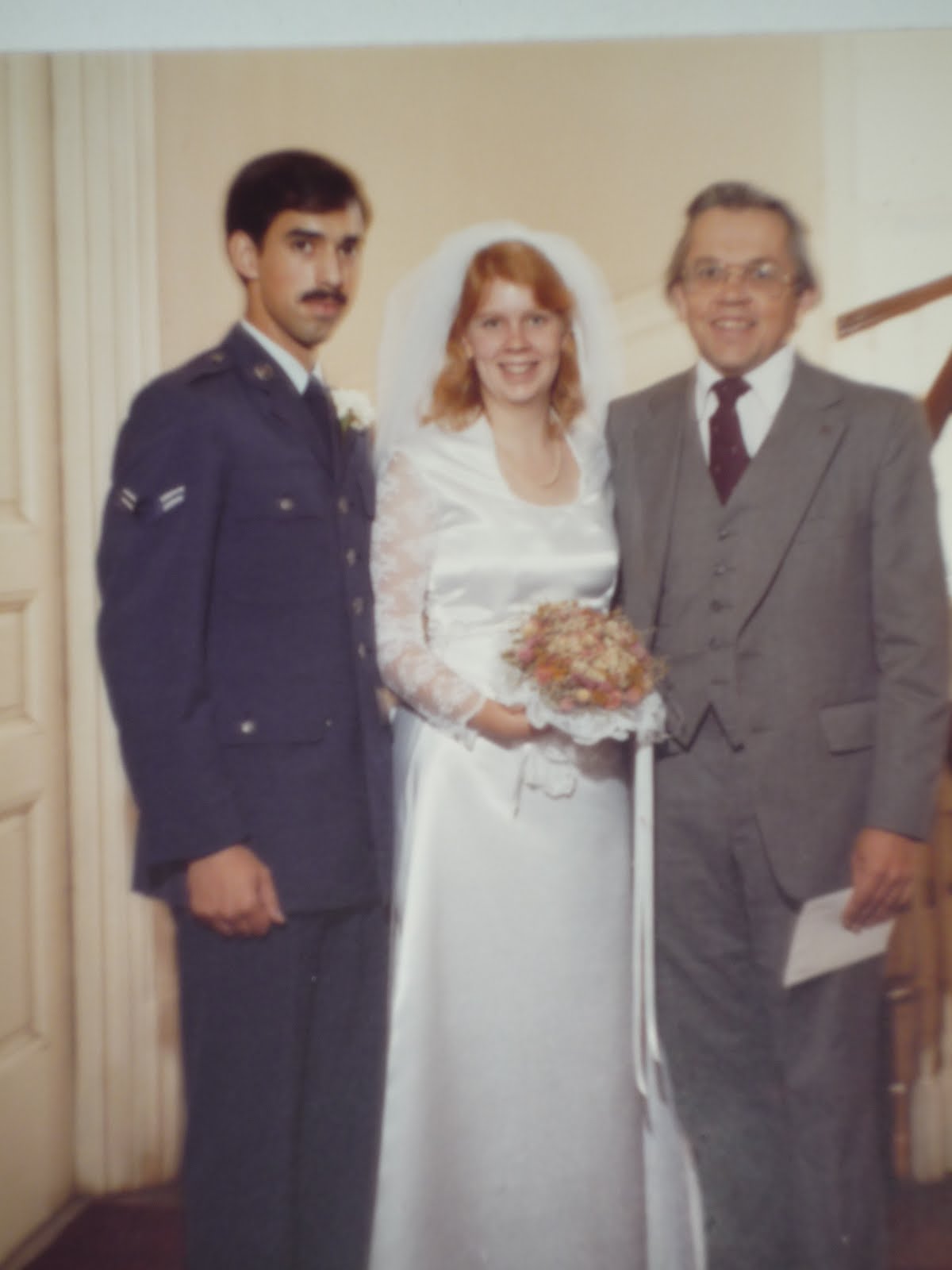
Stephen and I were married in the Unitarian Church in Worcester, Massachusetts where Stephen's family had been members for years.  The minister, Chris Raible, married us in 1981.  Chris is now living in Toronto,  Ontario, Canada.  I came across his name and e-mail address (for the first time since we were married) last Summer in an outdated Canadian History magazine called The Beaver that I found in a waiting-room. I contacted him to see if it was the same person.  It was, and we exchanged a few notes.  I was surprised he'd moved from Massachusetts to Ontario.
 

(Airman First Class; USAF Stephen Chrysostom, Jane (West) Chrysostom, Christopher Gist Raible, First Unitarian Church, Worcester Massachusetts, October 24, 1981)

Karin Bach who is originally from Ontario was raised in the Unitarian Church. I'm pleased that Karin met Allyn and Sara this past week.  Karin has been operating a unique lodging establishment called An Artist's Garden set in the woods of Albert County along scenic Route 915.  She has three self-contained efficiency suites that she designed, built, furnished, and decorated with her uniquely talented eye for taste, color, nature and quality.  She recently felled several large trees to give way for the spectacular views of Shepody Bay and Two Rivers Inlet that her secluded property overlooks.  My mother would be delighted; Pat frequently advised Karin about the potential of that obstructed view whenever she visited there, but during those earlier years when Karin was getting established with her pottery studio and building a home from the ground up a family was blooming--not easy years, I'd expect, and trees were probably not a priority unless they were already cut down and providing fuel for heat.  Karin is an especially hard worker and generous--two qualities my mother highly admired.

(Karin Bach, Patricia Carritt West, Hebron, New Brunswick, Canada)

My mother died in 2002.  We remember her in many ways, of course, but Stephen and I established a scholarship in her memory that recalls her good character, dedicated work ethic, and sense of humor through the qualifications of the scholarship recipient.  We've awarded six in as many years.  I try to imagine my mother reading and selecting qualified applicants, --she was a tough judge of character, and did not suffer fools gladly.  I can picture her Dollar-Rama (tm) readers perched on the end of her nose, wearing several layers of wool, lips pursed in concentration, with that light fixture pulled down close to the papers in an otherwise dark house.

Funny how we get to thinking about people, sometimes.

Monday, June 28, 2010

It only hurts when I laugh

We've all been asked the question.

Some of us take no time in coming up with the answer.  Some have several choices for their reply. Others have to really think about it, but eventually can find a suitable response.  Very few are stumped.

What is your most embarrassing moment?

The question is typically asked in a group setting, usually a party, so you have to choose your response carefully so you don't reveal too much about what causes you embarrassment (it might backfire on you later), or tell something you've done that you might not be proud of, or share part of your character that you might not want people who you're not very well acquainted with to know about you.

I have a few responses, but it's more a list of embarrassing things that I've said than done.  And now, faithful blog reader, you're preparing yourself for a humorous accounting of the gaffes, faux pas, blunders, and misspeaks that have rolled off my impetuous tongue in the course of these long years of adulthood.

Not a chance.

I think that inappropriate laughing is a better topic for this blog entry. Really!  Think about it. How many times have you been asked the question at a cocktail party?

"When was the worst time that you laughed inappropriately?" 

Imagine it, several of you are gathered around someone's living room with a drink, a small napkin with a puff pastry or stuffed mushroom that's too hot to eat--you know it, because the last one you ate scorched the roof of your mouth and you've been nursing it with an ice-cube from your drink for several minutes. People exchange topics about the work that they do, their kids' comings and goings, travels they've made--some guests you may know, some you're just getting acquainted with.

You've probably already pegged some of those who you don't know very well.

Type A:  The person who asks you a question, and before you've finished your response, they're answering it for you with the answer that they really wanted to give if you'd asked THEM the question.  For example,  "Have you ever been to California?" and you respond with "Well, funny you should ask, I've just been a few months ago, and found it to be much colder than I expected for this time of yea...." but they interrupt, and begin to tell you about their experiences in California, and you realize they really didn't care about your answer at all--they just had an agenda to start non-stop talking.

Type B:  The person who is everyone's very best friend, and knows everyone else in the room.  They find out something about you in some capacity, feign genuine interest in something that you're discussing, and promise you something in the future like:
a follow-up lunch
a book they'll put in the mail about the subject your discussing that they picked up at a yard sale but can't quite finish.
a telephone call with some information that would be pertinent for you to pursue

but you never hear from them again and you realize they are a big phony--so by now you spot them early on.

C:  The know-it-all.  Enough said.  Some esoteric subject has been brought up that piques your interest, and perhaps you know a few facts, but big mouth in the room, knows-it-all.  Or does he?

D:  Drinky McGluggerton.  He's just there for the alcohol;  he's actually amusing until he's had too many, at which point he becomes a little grouchy and frumps himself down in the Barcalounger (tm) in the corner and watches everyone else with a combative eye as the evening drags on.

But then the question is popped.  Has it ever before?  I doubt it.  Let's pretend it just has.
  
"When did you last laugh most inappropriately?"


My mother was a terrible offender.  But to her defense, and probably for most of us, an outburst of inappropriate laughter is usually an involuntary expression of stress or relief--(see The Jugular Vein blog entry)  --but not always.

When my mother was in a grocery store parking lot one cold wintry day after a freezing rain, she spied a woman who was pushing her heavily laden grocery cart out of the store to her vehicle.  The unaware woman hit a patch of ice, and the cart went wayward, while her feet went out from under her causing her to fall to her knees while keeping her grip on the cart.  The poor woman slid the entire length of the parking aisle flailing her legs to try regain her footing on the icy-slick pavement, but with no success.  By the time the cart came to a stop, and the woman could stand again, with torn stockings and bloodied knees, my mother was hysterical laughing.

Many years ago, we'd gone out to Bennett Lake in Fundy National Park.  We had an absolutely gorgeous wooden combination canoe-sail-row boat.  The Aphrodite.  It was very heavy, but the three of us (I was 13 at the time) could manage it well, and my parents could manage it with a bit of a struggle between the two of them.  Wally, would bark commands expecting an immediate and efficient response in action, while unloading the canoe and all its accessories from the top of the car until finally launching it into the water.  After several outings, we had a pretty good routine, each of us executing our job with the timely precision of a military mission.

Until one afternoon at the water's edge.  We were going sailing.  While I was setting the leeboards, Dad was righting the mast, and my mother tied the boom.  Something happened at this point, and the boom came down on Dad's head with an audible, and sharp CRACK!  Expletives were abundant, and my mother was immediately convulsed with laughter, which elicited even more expletives. 

After the tweety-birds stopped circling around Dad's head, we resumed our duties, and Dad returned to the rigging, when

CRACK!

it happened again.  Loud.  Hard. The angry sailor's vicious vocabulary was considerably more verbose.  My mother was unable to catch her breath from uncontrollable laughter.  It wasn't that she thought that it was funny, I'm quite sure it just was her coping mechanism. 

In our early days of home ownership in Omaha, we had a large Linden tree in the front yard that had several large, broken, and dangerous limbs that needed to be brought down.  At the time, we didn't have the standard set of homeowner tools like a tall ladder, a chain saw, or other necessary equipment to do the job safely or properly, but we were concerned that some of the dangling branches might come down and hurt someone.  Stephen drove our car up into the yard and stood on the roof to get a better look at them, and indeed, they were precarious limbs.

I advised him to just jump off the roof of the car, grab hold of the branch, and drop down with it as it should easily break off.  This was not good advice.

Stephen sprang off the roof of the car with the grace of an Olympic parallel-bar athlete, grabbed the diseased tree branch with both hands and stopped in time and motion for a few seconds when

SNAP!

the branch did break easily, but poor Stephen fell to the ground FAST and landed on his back completely knocking the wind out of him rendering him breathless and dizzy.  My immediate response should have been to rush to his side for assistance, but I didn't simply because I became helpless with a fit of manic hysterical laughter that I absolutely could not control.  Stephen was not amused.

(Remember when Mary Tyler Moore couldn't help herself at the funeral for Chuckles The Clown? )

Then there was a time when Olivia was in the hospital.  It was just one of several lengthy and successive stays when she was most sick several years ago.  The nursing staff knew us, and enjoyed Olivia--she was a model patient; she didn't cry, scream, or struggle during painful and invasive treatments, didn't demand toys or television or games, and tolerated the needles better than most adults.

An unfamiliar nurse came into her room one afternoon with a series of hypodermic needles to draw blood, and administer several medications through Olivia's IV.  She set the lot of the needles on Olivia's bedside table and turned her back to set up the procedural equipment when Olivia took on of the syringes and inadvertently inserted it directly through her hand---syringe on her palm side, the needle poking out the back of her hand.  Olivia calmly looked up at me from her bed and in a quiet monotone voice recognizing trouble held out her hand and said, "mummy?"

I laughed at first, because it was so incredulous that the thoughtless, careless, nurse would leave these syringes within Olivia's reach, and also because it looked so bazaar!  This strange anachronism of a small child's hand run through and through with a gleaming hypodermic needle filled with poison.  Certainly, not a laughing matter.

I think the next time I'm asked "What was your most embarrassing moment?" I'll return with the question "First, tell me when was the last time you laughed inappropriately?"  I think it will be a better conversation.

Either that, or I'll reply, "A little song, a little dance, a little seltzer down your pants." And see what happens.