We were famous for a few minutes. Our family of six was seated and posed in our tiny Lincoln Nebraska living-room, including our dog Scout, while the newspaper photographer silently took numerous shots of us. A few days later we were on the front page of the city newspaper in vivid color. It was an odd feeling to immediately recognize our own faces looking back from behind the little acrylic window in the box at the gas station that held the daily paper.
I bought the morning paper, and a few extra, and shortly after I got home, the phone started ringing. The first call was from the pet shelter who wanted to donate dog food for Scout. Several more supportive calls came offering money, babysitting services for our four children, group meeting times and places, and groceries. Lots and lots of groceries. We were overwhelmed by strangers' generosity and compassion.
We only spent a year in Lincoln. We rented an apartment just a few blocks away from Stephen's work. His boss had strongly suggested that a move to Lincoln would be a real gesture of Stephen's commitment and loyalty to the company, and consequently possibility for better opportunity and a secure future with them.
Previously, we had been living in Omaha for several years -just an hour's drive from Lincoln. We owned a very old home and had dug in, probably far too ambitiously and well beyond our capabilities, making improvements and renovations ever since we'd settled in and where we planned to raise our family. But life changed very quickly and it all started with a little girl's nosebleed.
After a series of dramatic events, we discovered that our youngest daughter, Olivia, had an unusual blood disease that required frequent hospitalizations, often in isolation, sometimes in critical care, and usually required several day's stay. It was a routine we were forced into like many families who have major medical issues. Our situation was not unique, it was just unique to us and we were managing as best as we could; Stephen had a decent job with medical insurance, and other than the long daily commute to Lincoln in a fairly reliable vehicle, we muddled through.
But then, we had to move to Lincoln.
We knew we had no possibility of selling the house in Omaha in its condition, so we shut it down, and made the 'commitment to the company' by moving close to Stephen's work and taking a year-long lease for an apartment in Lincoln that would allow pets and larger families. We traveled back and forth on weekends to continue working and making improvements on the house, either for a potential buyer, or for our future in Nebraska.
Three months later, Stephen was fired.*
Things got more difficult, but mostly just financially. We had a mortgage to cover, monthly rent at the apartment, and suddenly astoundingly astronomical hospital, medical, and doctor bills. Someone at the Lincoln newspaper got wind of our story and thought it was a good human interest piece reflecting the concerns of those with middle income and rising health insurance costs. We were featured since we suddenly had no job and no health insurance with serious medical costs and so we became the headline story, above the fold, on a weekday, in a Midwestern city newspaper for a day. Our fleeting moment of fame.
It took several years of treatments, countless hospitalizations and procedures, and surgery before Olivia was finally in full remission and considered cured. Those difficult years are ones I often look back on to measure how we've come along, and remember those who we encountered along the way --many leaving lasting impressions that in some ways have influenced who we are.
One elderly lady who had been living for several years in a senior citizen apartment complex called and invited us to her storage area in the basement of her building. In there, she had her own grocery store. She had rows of peanut butter jars, carefully arranged varieties of dried pasta and cans and jars of pasta sauces, boxed potatoes, neatly categorized row upon row of canned beans, vegetables, fruits and soups. Her son had built floor-to-ceiling two-by-four shelving all around her 6 foot by 8 foot allotted space and in there she had been storing surplus foods that she'd been purchasing ever since she'd moved in. For ten years. She explained she often invited people who were in situations like ours to visit with her. She was a child of the depression, and found that if there was a sale on something at the grocery store, she was compelled to bring extra home for someone who could use it. We left, very gratefully, with several bags of premium groceries for four growing young children.
We were reminded of this generous woman and her orderly and methodical ways of charity many, many years later. When we were doing some routine grocery shopping we noticed an elderly woman with several plastic shopping bags at the entrance to the store who appeared to be waiting in the cold for a ride. After we'd finished our own shopping and headed out to our car, she was still there.
We asked if she was expecting a ride or needed one --it was cold! She meekly suggested that she needed one, so Stephen immediately collected her bags, took her arm and we gave her a ride home which wasn't far from the store. When we got to her senior citizen apartment housing complex, Stephen carried her many grocery sacks in one trip and escorted her to her very small apartment while I waited in the car.
There she'd stashed what Stephen described as at least ten years of grocery purchases. However, these were all in bags, sacks, and indistinguishable piles of disarray and chaos. She invited Stephen in to her apartment and he set the bags of her most recent purchases among countless others of identical non-identifiable shape and abandon. She expressed her gratitude for the transportation, offering a generous contribution for our gas and the effort. Stephen left empty-handed but wide eyed with the contrast of a memory from a fairly similar scenario from years past. Two senior women, compelled to purchase more than they themselves could use or needed, but with entirely different intent.
A couple in Omaha offered us a day free from parenting and providing. She called in the morning, offering to take the three kids to the park and a variety of activities for the day, and returned with them tired and ready for bed at then end of the day providing soup and home made bread for supper. It offered us a chance to sit quietly, at home, taking several naps with a very ill child, worry-free from the needs of others and meals. It was a short, unexpected, and very appreciated respite that I often recall.
When our car broke down, our teen babysitter's family offered us their second vehicle so we could get around Omaha in winter until ours was repaired. An older friend offered us her credit card to pay for the repairs, knowing her bill would take a month to arrive, and we could take another to pay her.
A friend at church, a plumber by trade, helped in a most generous way with labour, advice, skill, and services when we moved back into our Omaha home from Lincoln after a year of shut off water and frozen pipes.
There were a lot of people who helped us along in a variety of ways during those short years, but we try not to dwell on the hardship; it's much more pleasant to remember the generosity of others, the details of laughter and friendship, the gestures of kindness.
I hope to always remember those who are kind and understand those who are not.
* Since another family in the company who had a terminally ill child was fired at about the same time, I'll always believe that the reason for the firings was because of the health insurance costs for the small company. I also suspect that Stephen's boss felt that his strongly suggested move to Lincoln (for a family of six needing proximity to a children's medical facility.) would be rejected and Stephen would resign. Oh--the wisdom of hindsight.
Saturday, January 22, 2011


Thursday, January 20, 2011
Guess What?
On several occasions over the years when I was growing up my Dad would quietly grin as he'd ask the question. As I recall it was usually timed just as we were lifting our forks to take the first bite of a meal as we five sat at the dinner table.
"Guess What?"
It immediately made my sister cry. My mother would set her fork back to her plate with a look of realization, steel herself, and simply state:
We're moving.
I'd be elated. But for everyone else in the family, it meant something different. For Dad it was a promotion, a new territory to cover for Norton Company, a better opportunity. For my mother, it meant selling a home, searching and buying a new one hundreds of miles away, and cleaning. Not just dusting and setting aside knick-knacks and gee-gaws to attract a potential buyer, but a thorough scouring and renewing of our house that was already in near pristine condition -often, one we'd lived in for just a few years.
Mayflower was the contracted mover for Norton Company, and the familiar green and yellow transport truck would pull up in front of our house with three men, blank newsprint and cardboard boxes. It was a good contract for them at our house, no doubt. We had books, and lots of them. Books are easy to pack and weigh a lot--benefits for the both business office and the packers at Mayflower. Also, our house was clean.
When they pulled a chest of drawers away from the wall, there was nothing there; no dust, no stray socks or missing toy parts, no intricate cobweb structures that had housed several generations--all that was there was the footprint of the furniture in the thoroughly vacuumed carpets. When the washing machine was disconnected, there was no lint, no detergent spills, no telltale sign of leaks that had repeatedly dripped and dried, just gleaming linoleum that was cleaner than most family's kitchen floor, all the while, my mother exclaiming and apologizing to the burly workers for the unsightly conditions, contritely suggesting that they must see some real 'doozies' of filth in their line of work. They'd nod politely and continue with their work while she'd kneel and wipe.
As a little kid, of course, I was oblivious to the concerns of my folks who had to oversee these operations, transitions, school transfers, mortgage approvals, title searches, interest rates, closing dates, car and pet licensing, and my siblings' emotional turmoil for the upheaval of yet another move. My brother and sister were several years older than me and they had to leave schools, friends, scouts, bands, and familiar neighbourhoods; mostly the ties that I never had or realized being much younger.
When a new home in a new state was ours, my mother acted as forward artillery and attacked all its imperfections, wear and tear, and the previous owner's dirt with fresh paint, and elbow grease. Our boxes would arrive ready to start again. We kids would start a new school -often in mid year, and then we'd do it all again, soon. A familiar routine, each with a unique story or memory.
A vivid memory is the move from Illinois to Michigan in dead winter in the late 60's. My sister and brother were in high school by then, and had several moves under their belts. I was seven. We stayed at The Mayflower hotel in downtown Plymouth, arriving tired on a blistering cold mid-winter's night. After a full day's drive in our Volkswagen bus, we were keen to get out of the car and get some warm elbow-room in the hotel. We walked up the wide stairs in the stately 30's era hotel, continued down a long hallway to our large 3rd floor room, and settled in. Beds were turned down, the heat turned up. Once pajama'd, we were ready to call it a night, but nature called and Buffy, our dog, needed one more run. To make a quick trip of it, shirtless, but wearing his pajama pants and socks, my brother Allyn took the dog to the fire escape at the end of the hall. Once outside, the door shut behind him and he quickly realized there was merely a two-foot square platform and he would be unable to get down to the street level carrying the dog on the iron-rung drop ladder. Too late, he also realized that the door was now locked from the inside. They were trapped.
As the rest of us slowly let the day drift away, it didn't occur to us that the knocking and muffled yelling outside was my brother --just a faint background noise in strange surroundings. He banged, hollered, and pounded on the thick fire door for a long time while holding a very unhappy dog who did not like being suspended several stories above ground on an open grid ironwork platform and wriggled earnestly to be freed. The pounding persisted, the yelling continued, until it worked its way to Dad's nearly asleep semi-consciousness when it occurred to him that Allyn and Buffy had been for gone quite a while. He poked his head out of the room to look and heard -much more clearly- the imploring racket. Back in the room, as Allyn warmed up and described his predicament, our laughter was even louder. My brother was not nearly as amused.
That was our last move together as a family. When I was in high school, my folks and I moved again to rural central Massachusetts. I watched, unseen as one mover whisked away my dress-making mannequin, and with a gruff voice, said, "C'mon baby, let's dance!" while he waltzed her all the way out to the truck. It's funny, the little details you remember that made big impressions. As adults Stephen and I moved many times with our growing family. Those moves, too, had some stresses and unique adventures we can recall --you may have read a few of them in earlier blogs.
After Stephen and I moved from Nebraska to New Jersey in the mid 90's, our family of six stayed at an extended stay hotel called Embassy Suites. We had a two room suite and they allowed pets. The company that had hired Stephen was paying for the stay while he worked as a consultant. The four kids and I went house hunting with real estate agents during the day. At the end of the day, we'd all meet up at the heated indoor pool, enjoy the Manager's Complimentary Cocktail Hour, and the kids swam while Stephen and I would catch up. Our spacious rooms, which had complete housekeeping services and two televisions included a full cooked-to-order breakfast every morning in the dining-room/courtyard. I quickly got used to the surroundings, routine --and luxury-- while we stayed there for several weeks.
Eventually, we found a home, the kids enrolled in school, and we started again. Justin started middle school and since the school year was well underway, he was quickly thrust into the curriculum and his science class required a few 'from home' supplies. Justin was asked to bring a raw potato the very next day. Not yet moved into the house, Justin matter-of-factly explained we didn't cook and didn't have any potatoes. The teacher, understandably, took this as a lame excuse to avoid the assignment and quickly chastised him and dismissed his excuse. Justin insisted he was being honest, and compromised that he could probably ask one of the kitchen staff for a potato. Now his teacher --with an entirely new assumption-- wanted more information about her new student and his 'kitchen staff' and asked where he lived. Justin simply replied, "The Embassy." She stopped asking questions and I think with our foreign sounding last name, it temporarily left quite an impression on her; it may have been Justin's first not-lie.
Recently, I hope, we've finally made our last move. Stephen and I have settled in at Cleveland Place. Here my folks, Pat and Wally, had done the spectacular and complicated forward artillery work with their battery of skills, taste and work ethic. We have the luxury of turning the key and comfortably settling in to continue the high standards that they set. The stories and memories and friendships they shared here are abundant, and we hope to carry on those standards and traditions. Except for one.
Guess What? Chicken Butt.
"Guess What?"
It immediately made my sister cry. My mother would set her fork back to her plate with a look of realization, steel herself, and simply state:
We're moving.
I'd be elated. But for everyone else in the family, it meant something different. For Dad it was a promotion, a new territory to cover for Norton Company, a better opportunity. For my mother, it meant selling a home, searching and buying a new one hundreds of miles away, and cleaning. Not just dusting and setting aside knick-knacks and gee-gaws to attract a potential buyer, but a thorough scouring and renewing of our house that was already in near pristine condition -often, one we'd lived in for just a few years.
Mayflower was the contracted mover for Norton Company, and the familiar green and yellow transport truck would pull up in front of our house with three men, blank newsprint and cardboard boxes. It was a good contract for them at our house, no doubt. We had books, and lots of them. Books are easy to pack and weigh a lot--benefits for the both business office and the packers at Mayflower. Also, our house was clean.
When they pulled a chest of drawers away from the wall, there was nothing there; no dust, no stray socks or missing toy parts, no intricate cobweb structures that had housed several generations--all that was there was the footprint of the furniture in the thoroughly vacuumed carpets. When the washing machine was disconnected, there was no lint, no detergent spills, no telltale sign of leaks that had repeatedly dripped and dried, just gleaming linoleum that was cleaner than most family's kitchen floor, all the while, my mother exclaiming and apologizing to the burly workers for the unsightly conditions, contritely suggesting that they must see some real 'doozies' of filth in their line of work. They'd nod politely and continue with their work while she'd kneel and wipe.
As a little kid, of course, I was oblivious to the concerns of my folks who had to oversee these operations, transitions, school transfers, mortgage approvals, title searches, interest rates, closing dates, car and pet licensing, and my siblings' emotional turmoil for the upheaval of yet another move. My brother and sister were several years older than me and they had to leave schools, friends, scouts, bands, and familiar neighbourhoods; mostly the ties that I never had or realized being much younger.
When a new home in a new state was ours, my mother acted as forward artillery and attacked all its imperfections, wear and tear, and the previous owner's dirt with fresh paint, and elbow grease. Our boxes would arrive ready to start again. We kids would start a new school -often in mid year, and then we'd do it all again, soon. A familiar routine, each with a unique story or memory.
A vivid memory is the move from Illinois to Michigan in dead winter in the late 60's. My sister and brother were in high school by then, and had several moves under their belts. I was seven. We stayed at The Mayflower hotel in downtown Plymouth, arriving tired on a blistering cold mid-winter's night. After a full day's drive in our Volkswagen bus, we were keen to get out of the car and get some warm elbow-room in the hotel. We walked up the wide stairs in the stately 30's era hotel, continued down a long hallway to our large 3rd floor room, and settled in. Beds were turned down, the heat turned up. Once pajama'd, we were ready to call it a night, but nature called and Buffy, our dog, needed one more run. To make a quick trip of it, shirtless, but wearing his pajama pants and socks, my brother Allyn took the dog to the fire escape at the end of the hall. Once outside, the door shut behind him and he quickly realized there was merely a two-foot square platform and he would be unable to get down to the street level carrying the dog on the iron-rung drop ladder. Too late, he also realized that the door was now locked from the inside. They were trapped.
As the rest of us slowly let the day drift away, it didn't occur to us that the knocking and muffled yelling outside was my brother --just a faint background noise in strange surroundings. He banged, hollered, and pounded on the thick fire door for a long time while holding a very unhappy dog who did not like being suspended several stories above ground on an open grid ironwork platform and wriggled earnestly to be freed. The pounding persisted, the yelling continued, until it worked its way to Dad's nearly asleep semi-consciousness when it occurred to him that Allyn and Buffy had been for gone quite a while. He poked his head out of the room to look and heard -much more clearly- the imploring racket. Back in the room, as Allyn warmed up and described his predicament, our laughter was even louder. My brother was not nearly as amused.
That was our last move together as a family. When I was in high school, my folks and I moved again to rural central Massachusetts. I watched, unseen as one mover whisked away my dress-making mannequin, and with a gruff voice, said, "C'mon baby, let's dance!" while he waltzed her all the way out to the truck. It's funny, the little details you remember that made big impressions. As adults Stephen and I moved many times with our growing family. Those moves, too, had some stresses and unique adventures we can recall --you may have read a few of them in earlier blogs.
After Stephen and I moved from Nebraska to New Jersey in the mid 90's, our family of six stayed at an extended stay hotel called Embassy Suites. We had a two room suite and they allowed pets. The company that had hired Stephen was paying for the stay while he worked as a consultant. The four kids and I went house hunting with real estate agents during the day. At the end of the day, we'd all meet up at the heated indoor pool, enjoy the Manager's Complimentary Cocktail Hour, and the kids swam while Stephen and I would catch up. Our spacious rooms, which had complete housekeeping services and two televisions included a full cooked-to-order breakfast every morning in the dining-room/courtyard. I quickly got used to the surroundings, routine --and luxury-- while we stayed there for several weeks.
Eventually, we found a home, the kids enrolled in school, and we started again. Justin started middle school and since the school year was well underway, he was quickly thrust into the curriculum and his science class required a few 'from home' supplies. Justin was asked to bring a raw potato the very next day. Not yet moved into the house, Justin matter-of-factly explained we didn't cook and didn't have any potatoes. The teacher, understandably, took this as a lame excuse to avoid the assignment and quickly chastised him and dismissed his excuse. Justin insisted he was being honest, and compromised that he could probably ask one of the kitchen staff for a potato. Now his teacher --with an entirely new assumption-- wanted more information about her new student and his 'kitchen staff' and asked where he lived. Justin simply replied, "The Embassy." She stopped asking questions and I think with our foreign sounding last name, it temporarily left quite an impression on her; it may have been Justin's first not-lie.
Recently, I hope, we've finally made our last move. Stephen and I have settled in at Cleveland Place. Here my folks, Pat and Wally, had done the spectacular and complicated forward artillery work with their battery of skills, taste and work ethic. We have the luxury of turning the key and comfortably settling in to continue the high standards that they set. The stories and memories and friendships they shared here are abundant, and we hope to carry on those standards and traditions. Except for one.
Guess What? Chicken Butt.
Tuesday, October 12, 2010
It rhymes with hurt
I take full responsibility.
It was the worst camping trip and worst Thanksgiving our family ever experienced and they still resent me for it. They bring it up whenever they give an example of how they've suffered by being a member of this clan. I dismiss their whining and assure them that it wasn't that bad. Stephen gently suggests that it was just as they describe and remember.
It started as my innocent effort to create a memorable Thanksgiving Day holiday before the kids all grew up and left the nest--Justin had just recently flown away. Otherwise, we had no real traditions or history associated with the holiday.
We rarely celebrated Thanksgiving most years since it was the tradition for gathering extended family around the table, grocery shopping, cooking, baking for days in preparation, and hosting traveling families arriving from any point in the country.
When Stephen and I were first married, we lived far from both of our families. I enjoyed playing house and preparing our small meals for just the two of us. In those early years, Stephen was in the Air Force. The base Morale Officers often sent young airmen and their wives to holiday functions hosted by senior-ranking officers around the base. We took advantage of the new friendships that those might offer and left the details and chores to other hosts.
In later years, when the kids were all quite little, I didn't really see the point of all the effort made for a special meal which would be consumed in short order creating extra cleanup work. Since both of our families were at least a thousand miles away, and rarely held big family gatherings, we ignored Thanksgiving and started our Solstice celebrations, instead.
So over the years, Thanksgiving was a holiday we'd enjoy, but only if we were invited away--we rarely made the effort to host our own. On the few occasions that we did, it just reinforced our opinion that we just weren't getting the true meaning of it all.
For example, when we were just getting settled in Omaha, we had a small circle of friends through The Unitarian Church and Stephen had a small circle of co-worker friends who, like us, were displaced in the Air Force, far from home-towns and family. We hosted a small group of unattached people and offered an open sideboard to which everyone was assigned what they could contribute to the meal. One guest, in charge of bringing a vegetable dish, brought a 7 pound raw acorn squash and set it in pride of place on the buffet, arriving just moments before dinner was served.
On the other hand, for more than one Thanksgiving, we were invited to the child-hood home of our church friend, Charlotte Shields, joining her parents Bill and Jean. Charlotte and her then husband, Al Vovolka, and their young son, Robin, took all nine of us, in a van they'd borrowed from another friend, to rural Red Oak, Iowa, crossing The Missouri River, and traveling over an hour past farm-fields and the rolling countryside of western Iowa. It really put us in the heartland and mindset of family, heritage, and tradition. Once we were in the farmhouse, surrounded by hundreds of acres of naked, recently-harvested, soybean fields, we sang songs while Charlotte accompanied with piano, listened to family stories, admired the artwork of Charlotte's mother, Jean, watched the kids play together, and created some remarkably happy memories in the most traditional way of holiday and setting.
On our first Thanksgiving visit, once seated at the table, Charlotte's father, Bill, asked that we go around the table to recite what we might be giving thanks for this year. I started to get nervous--I'm not very comfortable with genuine, heartfelt expressions of personal reflection or emotion. As we went around the table, I got an increasing case of tunnel vision as this close-knit family displayed their affection for the company, their love for their family, their gratitude for their health, and their delight in watching their grandson, Robin, grow and develop. By the time they got to me I was a sobbing, blubbering mess of uncontrollable emotion and appreciation for being included in this warm embrace of a family gathering. It was exhausting and a little confusing for the kids to see me in such an emotional state at a dinner table.
Growing up, my suburban family Thanksgivings were probably all very stereotypical. I just don't recall any vivid details or memories of them. I'm sure my mother slaved in the kitchen, preparing for the five of us: stuffing a turkey, mashing potatoes, and mixing pumpkin custard (she cooked everything by scratch), using few gadgets of convenience. Her cooking and preparation techniques were simple, food was good, and clean-up had the importance, efficiency, and sterility of a military hospital operating room after triage.
I remember one holiday spent with the Larson family of seven. Five children and parents, Ed & Jean. Ed and Dad worked at Norton Company together and our families were frequent companions for camping excursions, often centered around Ed and Dad's scuba diving expeditions. On one holiday, they joined our family in Plymouth, Michigan, which created a full table, mostly of teenagers, I --not yet a teen--was the youngest of the lot. I remember just sitting and watching the activity around me, and dearly recall the lively nature of the group and the laughter--non-stop laughter. Dad remarked that there wasn't a morsel of meat left on that turkey carcass--- like a cartoon turkey skeleton sitting on the platter when the meal was complete. I often think back to that particular brief moment in time, watching and listening to the frivolity and high spirit of many happy people seated around a full table. Frequently, I still use that image as a model when planning a dinner event.
So we fast forward to our own three teenagers, those still at home, and my efforts to combine the fun of a camping weekend and a memorable Thanksgiving Feast just a few miles south of our home in urban New Jersey. Historic Allaire State Park offered the setting--the only camping facility still open in late November. I booked our camp site at one of the few that had a permanent yurt set up with a fire pit outside and full length picnic tables, all located just a few hundred yards from the heated flush-toilet/shower house. This was going to be perfect; luxury camping compared to some of our past experiences.
We loaded the van with our most precious camping equipment, leaving the tent at home--we were going to be off the ground, on bunk-beds! More luxury!
Kathryn, Olivia and I acted as forward observers arriving in Mid-afternoon with all the necessary equipment: an 8-quart cast-iron dutch oven for the turkey, a 4-quart dutch oven for the pie, a three burner gas camp stove, 5 gallon water jugs, the Coleman (tm) lantern, a 60-quart marine cooler full of food, sleeping bags, and the chuck box:
This is an elaborate wooden cabinet with drop-down sides, pop out drawers, and a lift-off piano-hinged top that Stephen built for me fashioned after the chuck-box I remembered growing up as a child. My grandfather, Allyn, had built it years before and it was always used as our camp kitchen and pantry. Stephen's version was a little more sophisticated, featuring cubbies for my Tupperware (tm) spice containers--everything from salt to sage, a slide-out for my stainless steel flatware (service for 12), a hanging shelf for KP duties-soap, dishcloth, SOS scrubbing pads, hooks for soup ladles, pancake turners, sausage tongs, mixing spoons, wire whisks, carving knives, and shelves for my traveling canisters of flour, sugar, baking powder and soda, coffee, chocolate, and tea, and enough plates, cups, bowls, and mugs for at least 12 people.
 |
| The chuck box, in happier times. |
Since we were about to dig in to prepare a simple but full Thanksgiving meal, I needed all the right tools. We set the fire just right, employing hot coals to roast the turkey in the dutch oven, the girls mixed the ingredients for a pumpkin pie and home-made pie crust, I heated a pan for cranberry sauce, made a slurry of flour and coffee to simmer gravy with the turkey drippings, set several pounds of potatoes to boil and mash, and made efforts to keep-kamp before Stephen and Andrew joined us after work.
 |
| Remember, nothing's more fun than gathering sticks. NOTHING! |
Caught in typical pre-holiday New Jersey rush-hour traffic, the one-hour drive, took over two, while the girls and I puttered about the campsite, anxiously but silently noticing the setting sun, and more of a concern, the rapidly falling temperature. The table was set with coordinating Tupperware (tm) plates, tumblers, flatware, serving dishes, and eventually--finally-- Stephen and Andrew arrived.
It was either because we were starving and shivering or because no one dared say otherwise, but I thought it was the BEST Thanksgiving meal we'd EVER eaten--before or since.
 |
| Nothing says camping like setting everything on fire. |
The turkey was roasted to perfection, the drippings providing a robust base for a savoury gravy, the stuffing was moist and aromatic with spices and homemade bread, the cranberries jellied sweet and tart, the potatoes soft as silk, a buttery, creamy vessel for a puddle of gravy. A meal of perfection. Eaten in less than 10 minutes. In darkness.

Immediately after the meal, we quickly began KP at the Camp Sink:
Another of Stephen's creations at my request. Our camp sink station. He built a wooden tabletop using the legs from a discarded folding table, and attached footings to the table top that would hold a shelf strong enough to support two filled 5-gallon water jugs. One for hot water, the other for cold. He plumbed one of jugs' spigots to have a sprayer hose to make dish-washing effortless and aseptic The table top had ample room for a large stainless steel basin used for a sink.

Once clean-up was done--not so easy in the dark, most unpleasant in the cold--and after vainly trying to stay warm around the dwindling campfire, we abandoned story-telling and harmonica playing and retired to the yurt:
A yurt is a semi-permanent, but portable, dwelling traditionally used by nomads in Asia. It's constructed of canvas around a lattice-work frame and roofed--more cabin-like than tent-like.
 |
| The Yurt. Sleeps up to six, freezes up to eight. |
This being New Jersey, there was no hand-felted roof made by Mongolian shepherds, and our flashlights revealed the many names carved into the planks and wood bunk frames of previous visitors.The yurt also had a large permanently framed sign stating that under no circumstances would stoves, fires, or heaters of any kind be permitted in the yurt. So, the kids each took a bunk, unrolled their -30 degree ranked sleeping bags, and Stephen and I zipped our sleeping bags together and unrolled a sleeping mat on the floor. We all hunkered down for the night.
But the temperature kept dropping.
and dropping.
We tossed, we cuddled, we adjusted, we zippered our heads into the bag. We just couldn't get warm--no one could get warm. We could hear teeth chattering. Frequently, someone would get up and 'go to the bathroom', but they were really just warming up in the heated facility. It was a long, cold, uncomfortable night. I was sure I'd make it up to them all by making a fabulous camp breakfast: eggs, sausage, pancakes, hot coffee, the works.
When first daylight came, we stirred, and I was first to get the morning routine going. I went to fill the kettle for a large pot of strong coffee, but the water jugs had frozen. Solid. The gas stove (the ever-faithful Coleman pressure pump) wouldn't hold a charge, so I couldn't get a burner lit. I started a new camp fire; I could make pancakes and sausage over the flames.

We'd spent all our collected wood the night before trying to get warm, so I sent the kids to forage for kindling and branches. They culled enough to get a modest fire going and I made pancakes. The butter was frozen, but worse, the maple syrup wouldn't pour. Anything we left outside of the cooler froze, anything inside the cooler was fine.I didn't think real maple syrup could freeze at all, but this was as close to frozen as it could get. The kids were as frozen as they thought they could get.


So tradition was lost, very little fun was had, I created way too much work for a simple turkey meal, and, really, everyone just wanted just to go home. So much for Thanksgiving.
I'm remembering this particular Thanksgiving celebration since we just celebrated our Canadian Thanksgiving. (It's the same weekend as the US Columbus Day.) So what am I thankful for? It's simple; A vivid memory of a time spent with friends and family, ultimately, a story to share.
Mostly, that no one lost any toes to hypothermia.
 |
| In the background, Andrew and Kathryn stare dully at a tent bag. It's the most fun they had all weekend. |
Wednesday, August 4, 2010
Good Art Doesn't Match Your Sofa.
I like a good short story. An anecdote. An amusing recounting of events among friends Here's a quick one.
Several years ago we received an invitation to a local Albert County art gallery called Joie de Vivre which was having a seasonal grand opening featuring several Maritime artists.
At the time, I didn't have many acquaintances in the area and not wanting to go to the intimate event alone, I was happy to be accompanied by a woman who was visiting her family in the area on holiday. She's since divorced, but at the time, she was married to John, the son of our good friend, Dick Squiri from Waterside. Doree and John lived in the United States, and were spending a few days visiting Dick at their long-time family summer home. We'd often been invited over for suppers or cocktails, and met most of the extended Squiri family over time.
After one especially lively lobster chowder supper, John and I were in the kitchen finishing up the dishes and cleaning the counters and pots and pans. After all the dishes were done and the sink drained, I asked John where to put the drain's garbage and he showed me the switch for the garbage disposal, which I promptly pretended to activate with one hand while my other hand was clearly still in the drain and made the motions and frightening sounds of someone whose hand was being macerated.
John was not amused and stopped fast, met my eyes, and said, "That's not funny at all, don't ever do that again." Humbled, I stopped, withdrew my hand, and flatly said, "okay, I'll never do it again." We finished the last of the kitchen chores in chilled silence. I felt very small.
Doree, however, seemed more easily amused, and told me not to worry about it--explaining that John sometimes takes himself too seriously. I don't think anyone should take themselves too seriously. When she called later and suggested we go together to the opening, I was pleased to be asked. She drove her luxury car and we chatted amiably on the 25 minute trip. A nice getaway on a clear Fall day.
The Gallery was very nicely appointed with high-end artwork of every variety: pottery, metal-smith jewelery, sculptures, photography, and artwork in several mediums. Several of the artists were local, and all of them talented. Joie de Vivre was a small gallery, but tastefully arranged to keenly feature each artist's creations in the historic building.
Throughout our quiet tour, we both made polite comments about the different works of art, sometimes we would separate momentarily if we lingered over a specific piece and then meander back together, raise our eyebrows about prices; some high, others very high, and cluck our tongues at pieces or works that we just didn't like or understand.
On the newly renovated second floor, one unframed painting immediately caught my eye. It was titled Two Drowned Rats, and was just that. A pale, unfocused background, featuring two very dead rats --on their backs, eyes closed, paws in the air, long tails extended-- in realistic detail in the foreground. It was simple, to the point, matter of fact. I liked it.
I remarked to Doree, "Gee, wouldn't that be great in the baby's nursery?" and to my relief, she saw that I was joking, and we shared a laugh.
But the more I looked at it, the more I liked the painting and was compelled to ask the gallery owner about the artist and if there was a story behind it.
It, too, was simple. The artist had passed her garden rain barrel which was full after seasonal storms, and saw the two rats, dead-- but afloat. She removed them by their tails and laid them nearby on a barn board, stiff and wet. And then she began to paint. Easy as that.
So, overall, the event was lovely; I had a nice outing with a new acquaintance, enjoyed some finger sandwiches and punch and had a laugh with someone who shared my sense of humor--few do. A good day.
I told my folks about our day, the artwork on display, and my keen interest on the very expensive but compelling painting on the second floor.
The next day, Dad bought me the painting and eventually Stephen made me a frame out of re-claimed barn board so we could hang it in pride of place in our living room. Over the years, it has caught the eye of several guests and served as a conversation piece on different occasions. The scene is neither gruesome nor pitiful; it's just a fact of life. Sometimes, I think we should look at a lot in life with that approach, hopefully finding peace in the end.

I suppose that's easy to say when it's about rats.
Several years ago we received an invitation to a local Albert County art gallery called Joie de Vivre which was having a seasonal grand opening featuring several Maritime artists.
At the time, I didn't have many acquaintances in the area and not wanting to go to the intimate event alone, I was happy to be accompanied by a woman who was visiting her family in the area on holiday. She's since divorced, but at the time, she was married to John, the son of our good friend, Dick Squiri from Waterside. Doree and John lived in the United States, and were spending a few days visiting Dick at their long-time family summer home. We'd often been invited over for suppers or cocktails, and met most of the extended Squiri family over time.
After one especially lively lobster chowder supper, John and I were in the kitchen finishing up the dishes and cleaning the counters and pots and pans. After all the dishes were done and the sink drained, I asked John where to put the drain's garbage and he showed me the switch for the garbage disposal, which I promptly pretended to activate with one hand while my other hand was clearly still in the drain and made the motions and frightening sounds of someone whose hand was being macerated.
John was not amused and stopped fast, met my eyes, and said, "That's not funny at all, don't ever do that again." Humbled, I stopped, withdrew my hand, and flatly said, "okay, I'll never do it again." We finished the last of the kitchen chores in chilled silence. I felt very small.
Doree, however, seemed more easily amused, and told me not to worry about it--explaining that John sometimes takes himself too seriously. I don't think anyone should take themselves too seriously. When she called later and suggested we go together to the opening, I was pleased to be asked. She drove her luxury car and we chatted amiably on the 25 minute trip. A nice getaway on a clear Fall day.
The Gallery was very nicely appointed with high-end artwork of every variety: pottery, metal-smith jewelery, sculptures, photography, and artwork in several mediums. Several of the artists were local, and all of them talented. Joie de Vivre was a small gallery, but tastefully arranged to keenly feature each artist's creations in the historic building.
Throughout our quiet tour, we both made polite comments about the different works of art, sometimes we would separate momentarily if we lingered over a specific piece and then meander back together, raise our eyebrows about prices; some high, others very high, and cluck our tongues at pieces or works that we just didn't like or understand.
On the newly renovated second floor, one unframed painting immediately caught my eye. It was titled Two Drowned Rats, and was just that. A pale, unfocused background, featuring two very dead rats --on their backs, eyes closed, paws in the air, long tails extended-- in realistic detail in the foreground. It was simple, to the point, matter of fact. I liked it.
I remarked to Doree, "Gee, wouldn't that be great in the baby's nursery?" and to my relief, she saw that I was joking, and we shared a laugh.
But the more I looked at it, the more I liked the painting and was compelled to ask the gallery owner about the artist and if there was a story behind it.
It, too, was simple. The artist had passed her garden rain barrel which was full after seasonal storms, and saw the two rats, dead-- but afloat. She removed them by their tails and laid them nearby on a barn board, stiff and wet. And then she began to paint. Easy as that.
So, overall, the event was lovely; I had a nice outing with a new acquaintance, enjoyed some finger sandwiches and punch and had a laugh with someone who shared my sense of humor--few do. A good day.
I told my folks about our day, the artwork on display, and my keen interest on the very expensive but compelling painting on the second floor.
The next day, Dad bought me the painting and eventually Stephen made me a frame out of re-claimed barn board so we could hang it in pride of place in our living room. Over the years, it has caught the eye of several guests and served as a conversation piece on different occasions. The scene is neither gruesome nor pitiful; it's just a fact of life. Sometimes, I think we should look at a lot in life with that approach, hopefully finding peace in the end.

I suppose that's easy to say when it's about rats.
Friday, July 2, 2010
the cooling breeze of relief
Dad bought a new car nearly every year. I don't think my mother ever really cared--she never got very excited about them, she just appreciated a trustworthy vehicle to get her from point A to point B.
Until the year the Chrysler PT Cruiser came out.
She admired that car and would remark on it when she saw one on the road. For the first time, I saw her excited about a new car when the PT Cruiser was delivered and sitting in the driveway at Cleveland Place: Silver metallic pearl coat, retro-style-- featuring a retractable moon roof, power windows, all the bells and whistles including cruise control.
Dad bought it for her. It's the first car in all their years that she ever really requested or that I remember she ever showed an interest. She said it reminded her of her childhood. She didn't drive it often, and she rarely drove when the two of them went anywhere, together. She frequently let me drive it when we went somewhere together--a nice new, tight, efficient and compact vehicle. The ideal automobile for pleasant day drives and comfort while running errands.
There was a time, shortly before my mother died, that she was feeling rather puny, and one complaint evolved into several, and eventually she ended up with a case of pneumonia and bronchitis--a serious concern for a lung-cancer survivor-- that ultimately required some chest x-rays and a cat scan to rule out anything more complicated.
Understandably, for Pat, this conjured up wicked memories of the horrific time twenty years earlier when she'd successfully battled a malignant case of what was thought to be incurable lung cancer, and she doubted she could face another round either physically or emotionally at that point in her life.
So, I visited and became her morale officer while she underwent these tests and we waited several anxious days for the results. We played Scrabble (tm), ironed placemats, competed at Triple Yahtzee (tm), washed and waxed the kitchen floor, and busied ourselves with otherwise mundane and distracting household chores while she pretended not to fret.
To get to one of these tests, Dad put us all in her PT cruiser and drove the scenic, country, remote Albert County roads by-passing the usual route to get to the city and hospital. We wended our way along The Chocolate River at Hopewell Cape, cruised through The Albert Mines Road, passed through Hillsborough following the old train rails along back roads, and solemnly watched the scenery pass by our windows on an otherwise cheerfully sunny and crisp fall day. We arrived at hospital in time for Pat's appointments. She was being quietly cheerful and brave, but you could see the concern and the dread of anticipation for both the procedure and feared results.
When she was all done, we made the return trip home while Dad drove in silence. He's not a fellow who communicates his worries, concerns, fears, or emotions. Not unless it's anger--the one outward emotion he easily expresses. His concerns were heavy.
Although there was some relief after the procedures were done; a first hurdle overcome, but what remained was the dread--the 'what if....' so there was still no light-hearted banter in the car on the trip home. There was little conversation. It was clear they were both tossing worries about in their own thoughts as the car and its quiet occupants meandered along.
Coming back home through some of the less frequently traveled by-ways revealed some spotty road surfaces which I especially noticed as the passenger in the rear seat behind my mother sitting in the front.
Sitting cross legged, and leaning slightly forward to hear any sparks of conversation my free leg would jostle and bounce with every frost heave, bump, pothole, and rough patch in the road, and I frequently had to re-adjust my position re-crossing my legs.
Meanwhile, though it was a nice sunny day, it was a cool day. My window was continuously lowering and raising every few moments. Down the window would silently lower just an inch or two, then up again to be closed. Seconds later the window was sent wide open, and a gust of late afternoon chill would blast in. Then just as quickly the window would return to the half-way point and remain until it was raised a few more inches, then a few more until it was closed, and then almost immediately sent back down again in increments of no particular preference.
This continued for several long miles, with such repetition and so erratically that I surmised that Dad must be doing it to be silly, not to actually adjust the comfort level in the car. After all, my mother--in all her wool and tweed--would be the LAST person he'd consider would need an occasional cool blast of air. Up, down, half-way up again, down a little, one inch, two inches, stop, back up again, closed fully, open entirely, down again for an inch, another inch, another inch, back up again....
Silly, Dad--sweet silly Dad, trying to get a reaction--create a distraction; anything to stop thinking the worst---mum's head was bowed, no doubt, she was deep in thought.
Then the car suddenly slowed, Dad downshifted, slowed more. Pat's head perked up--something in the road? My window was now descending to its fully lowered position as I strained leaning further forward to see what caused Dad's change in course.
He stopped turned and looked straight at me and said, "You know that you're doing that, don't you?"
"Doing WHAT?" I asked, afraid of the answer--afraid that since I knew wasn't being sparkly, cheerful, and offering a ray of sunshine for this cloud of doom that was above all our heads--and was especially black over my mother's, I was going to be blamed for the somber and heavy atmosphere in the car. What good am I if I don't lighten the mood and offer positive quips and remarks? He's right: I was a failure in my duties as Head of Optimism.
He then pointed to the console between the two bucket seats where the rear-seated passenger can control their own window by the small electric power switch.
Apparently, with each bump and jostle, my foot was hitting the switch and activating the window. He wasn't doing it at all; I was-and I was completely unaware.
My mother quietly said, "Stupid.".
I laughed. I laughed loud and hard. I laughed louder and harder. Here I'd been sitting-- my hair blown into a Flock of Seagulls hairstyle, my hearing distorted, I was alternately uncomfortably cold with blasting wind with the wide open window and then annoyed by the baffled noise of the nearly closed window, and for all those passing miles, I'd been the unknowing operator.
It caught on. Dad laughed, Mum laughed, we laughed together, we laughed long and loud. Dad started up again, and on we went. It was a small distraction, but it worked. Frivolity crept back into our lives for a few moments, there, and it felt good. That doom cloud was temporarily lifted.
Back home, after a stressful week of waiting, the call came. Mum took it in the office. Dad and I sat at the dinner table. Silent.
We heard a quiet "Thank you, Doctor." and she emerged. Tears in her eyes. We didn't ask.
She came back into the dining room and she tearfully said with quiet relief, "He said I'm going to be fine; there's nothing in my brain, and the shadow on the chest x-ray was just my nipple."
That was the first time in my life I ever heard my mother use the word nipple. I snickered.
Until the year the Chrysler PT Cruiser came out.
She admired that car and would remark on it when she saw one on the road. For the first time, I saw her excited about a new car when the PT Cruiser was delivered and sitting in the driveway at Cleveland Place: Silver metallic pearl coat, retro-style-- featuring a retractable moon roof, power windows, all the bells and whistles including cruise control.
Dad bought it for her. It's the first car in all their years that she ever really requested or that I remember she ever showed an interest. She said it reminded her of her childhood. She didn't drive it often, and she rarely drove when the two of them went anywhere, together. She frequently let me drive it when we went somewhere together--a nice new, tight, efficient and compact vehicle. The ideal automobile for pleasant day drives and comfort while running errands.
There was a time, shortly before my mother died, that she was feeling rather puny, and one complaint evolved into several, and eventually she ended up with a case of pneumonia and bronchitis--a serious concern for a lung-cancer survivor-- that ultimately required some chest x-rays and a cat scan to rule out anything more complicated.
Understandably, for Pat, this conjured up wicked memories of the horrific time twenty years earlier when she'd successfully battled a malignant case of what was thought to be incurable lung cancer, and she doubted she could face another round either physically or emotionally at that point in her life.
So, I visited and became her morale officer while she underwent these tests and we waited several anxious days for the results. We played Scrabble (tm), ironed placemats, competed at Triple Yahtzee (tm), washed and waxed the kitchen floor, and busied ourselves with otherwise mundane and distracting household chores while she pretended not to fret.
To get to one of these tests, Dad put us all in her PT cruiser and drove the scenic, country, remote Albert County roads by-passing the usual route to get to the city and hospital. We wended our way along The Chocolate River at Hopewell Cape, cruised through The Albert Mines Road, passed through Hillsborough following the old train rails along back roads, and solemnly watched the scenery pass by our windows on an otherwise cheerfully sunny and crisp fall day. We arrived at hospital in time for Pat's appointments. She was being quietly cheerful and brave, but you could see the concern and the dread of anticipation for both the procedure and feared results.
When she was all done, we made the return trip home while Dad drove in silence. He's not a fellow who communicates his worries, concerns, fears, or emotions. Not unless it's anger--the one outward emotion he easily expresses. His concerns were heavy.
Although there was some relief after the procedures were done; a first hurdle overcome, but what remained was the dread--the 'what if....' so there was still no light-hearted banter in the car on the trip home. There was little conversation. It was clear they were both tossing worries about in their own thoughts as the car and its quiet occupants meandered along.
Coming back home through some of the less frequently traveled by-ways revealed some spotty road surfaces which I especially noticed as the passenger in the rear seat behind my mother sitting in the front.
Sitting cross legged, and leaning slightly forward to hear any sparks of conversation my free leg would jostle and bounce with every frost heave, bump, pothole, and rough patch in the road, and I frequently had to re-adjust my position re-crossing my legs.
Meanwhile, though it was a nice sunny day, it was a cool day. My window was continuously lowering and raising every few moments. Down the window would silently lower just an inch or two, then up again to be closed. Seconds later the window was sent wide open, and a gust of late afternoon chill would blast in. Then just as quickly the window would return to the half-way point and remain until it was raised a few more inches, then a few more until it was closed, and then almost immediately sent back down again in increments of no particular preference.
This continued for several long miles, with such repetition and so erratically that I surmised that Dad must be doing it to be silly, not to actually adjust the comfort level in the car. After all, my mother--in all her wool and tweed--would be the LAST person he'd consider would need an occasional cool blast of air. Up, down, half-way up again, down a little, one inch, two inches, stop, back up again, closed fully, open entirely, down again for an inch, another inch, another inch, back up again....
Silly, Dad--sweet silly Dad, trying to get a reaction--create a distraction; anything to stop thinking the worst---mum's head was bowed, no doubt, she was deep in thought.
Then the car suddenly slowed, Dad downshifted, slowed more. Pat's head perked up--something in the road? My window was now descending to its fully lowered position as I strained leaning further forward to see what caused Dad's change in course.
He stopped turned and looked straight at me and said, "You know that you're doing that, don't you?"
"Doing WHAT?" I asked, afraid of the answer--afraid that since I knew wasn't being sparkly, cheerful, and offering a ray of sunshine for this cloud of doom that was above all our heads--and was especially black over my mother's, I was going to be blamed for the somber and heavy atmosphere in the car. What good am I if I don't lighten the mood and offer positive quips and remarks? He's right: I was a failure in my duties as Head of Optimism.
He then pointed to the console between the two bucket seats where the rear-seated passenger can control their own window by the small electric power switch.
Apparently, with each bump and jostle, my foot was hitting the switch and activating the window. He wasn't doing it at all; I was-and I was completely unaware.
My mother quietly said, "Stupid.".
I laughed. I laughed loud and hard. I laughed louder and harder. Here I'd been sitting-- my hair blown into a Flock of Seagulls hairstyle, my hearing distorted, I was alternately uncomfortably cold with blasting wind with the wide open window and then annoyed by the baffled noise of the nearly closed window, and for all those passing miles, I'd been the unknowing operator.
It caught on. Dad laughed, Mum laughed, we laughed together, we laughed long and loud. Dad started up again, and on we went. It was a small distraction, but it worked. Frivolity crept back into our lives for a few moments, there, and it felt good. That doom cloud was temporarily lifted.
Back home, after a stressful week of waiting, the call came. Mum took it in the office. Dad and I sat at the dinner table. Silent.
We heard a quiet "Thank you, Doctor." and she emerged. Tears in her eyes. We didn't ask.
She came back into the dining room and she tearfully said with quiet relief, "He said I'm going to be fine; there's nothing in my brain, and the shadow on the chest x-ray was just my nipple."
That was the first time in my life I ever heard my mother use the word nipple. I snickered.
Tuesday, June 29, 2010
making connections
My Dad, Wallace, was recently visiting in the kitchen at Cleveland Place and reached up to pull down and turn on the light fixture in the kitchen ceiling. He had purchased it at least a dozen years ago at the auction of a long-time friend, Rod MacKay. Rod is an accomplished Maritime artist who we met over thirty years ago in Sussex, New Brunswick, but currently lives in Nova Scotia. We have a large collection of Rod's work that represent several periods in his life which feature New Brunswick scenes and people.

I remarked to dad that another friend, Karin Bach, who lives just a few kilometers away, had bid on one of Rod's large floor easels at that same auction but she insisted that Rod autograph the easel before she finalized the transaction. Dad wasn't aware of that even though he had spent the entire day at the auction assisting Rod and the auctioneers. Karin currently uses that easel in her studio; she is an exceptionally talented sculpture artist and painter.

Dad returned his gaze to the unusual antique light fixture and described how he'd engaged in a bidding war with another Bed and Breakfast owner from Saint John who ran an establishment called Home Port. Dad refused to relent in the bidding, and eventually won the bid, at a much higher price than he'd intended to pay. The fixture was ideal for the Cleveland Place kitchen, both because it was a unique antique and its style fit the era of the home.

After the auction, Dad explained to the operator of Home Port why he was such stubborn competition for the fixture and they shook hands. Later, Dad sent the fellow a copy of a book titled Home Port that is from our private collection of Olive Higgins Prouty books which includes her self-published memoir. For Home Port, Mrs. Prouty consulted my grand-father (Dad's Dad), Allyn West I, for information to help her accurately and authentically describe the events of an overturned canoe in the water as part of the plot. Allyn and Wallace had built a few boats between them, and Allyn was an authority in all wood and water craft.


A story of a man who becomes a fugitive from his own identity.

Fronts piece autographed to Allyn West I by Prouty
Our nephew, Allyn West III, and his bride, Sara have just left Cleveland Place. They spent a week with us after their road trip from Houston, Texas. Allyn is a doctoral candidate (journalism/literature), writer, poet, thinker. Both Sara and Allyn remarked on the unfinished MacKay painting in their guest-room. Of the over 30 paintings in the MacKay collection, I think that particular one is the most haunting and evocative, (Rod was working on that canvas when his first wife, Anne, was terminally ill with cancer; when she died, it remained unfinished.) and I admired that they remarked on it. It didn't occur to me to ask Allyn if he was aware of these details until this afternoon. We'd spent some time during his visit sharing a variety of little-known family histories---several of them significant and local in New Brunswick, and anecdotes and photographs; most of them happy ones, a few were depressing, but important to remember.


Sylvia Plath was depressed. She may have been bi-polar. She benefited from the generosity of Mrs. Prouty who, as a fellow author and Bostonian, became a benefactor to Plath both for her tuition expenses through a scholarship and cost of her treatments for depression. I imagine that by today's standards and practices of medicine, those treatments must seem barbaric. Plath modeled one of the characters in her book The Bell Jar after Mrs. Prouty. Sylvia committed suicide a short time after that book went to print.
Mrs. Prouty was a member of the Unitarian Church across the street from her estate in Brookline, Massachusetts. As a high-school student, Dad mowed the estate lawns of Lewis and Olive Prouty for twenty-five cents an hour. He also took one of her many cars luxury cars without her permission on at least one occasion which resulted in some serious punishment from his dad.

My mother's father, Ernest Henry Carritt, was a Unitarian minister. (Not at the Brookline church--but at parishes in Ohio, Illinois, and New Hampshire). I don't know much about Ernest's career, except that he was relieved of one of his appointments at a parish in the midwest in the 40's when he invited an African-American family in the town to join his congregation. Also an accomplished wood-worker, Ernest built an altar for the chapel at the Joliet Prison in Illinois. The prison has been closed for several years, now, and I wonder what ever happened to his altar. After he retired--with no pension from the church-- everything that Ernest built in and for his home, hand-crafted, wrote (sermons, lettters, etc.) and all the books he'd collected were destroyed in a fire by arson at their home in New Hampshire in the 60's. His only daughter, (Ernest had a son, Dayton, with his first wife who died.) Patricia, had few mementos of his life and career which have been left to our family archives.


Stephen and I were married in the Unitarian Church in Worcester, Massachusetts where Stephen's family had been members for years. The minister, Chris Raible, married us in 1981. Chris is now living in Toronto, Ontario, Canada. I came across his name and e-mail address (for the first time since we were married) last Summer in an outdated Canadian History magazine called The Beaver that I found in a waiting-room. I contacted him to see if it was the same person. It was, and we exchanged a few notes. I was surprised he'd moved from Massachusetts to Ontario.

Karin Bach who is originally from Ontario was raised in the Unitarian Church. I'm pleased that Karin met Allyn and Sara this past week. Karin has been operating a unique lodging establishment called An Artist's Garden set in the woods of Albert County along scenic Route 915. She has three self-contained efficiency suites that she designed, built, furnished, and decorated with her uniquely talented eye for taste, color, nature and quality. She recently felled several large trees to give way for the spectacular views of Shepody Bay and Two Rivers Inlet that her secluded property overlooks. My mother would be delighted; Pat frequently advised Karin about the potential of that obstructed view whenever she visited there, but during those earlier years when Karin was getting established with her pottery studio and building a home from the ground up a family was blooming--not easy years, I'd expect, and trees were probably not a priority unless they were already cut down and providing fuel for heat. Karin is an especially hard worker and generous--two qualities my mother highly admired.

My mother died in 2002. We remember her in many ways, of course, but Stephen and I established a scholarship in her memory that recalls her good character, dedicated work ethic, and sense of humor through the qualifications of the scholarship recipient. We've awarded six in as many years. I try to imagine my mother reading and selecting qualified applicants, --she was a tough judge of character, and did not suffer fools gladly. I can picture her Dollar-Rama (tm) readers perched on the end of her nose, wearing several layers of wool, lips pursed in concentration, with that light fixture pulled down close to the papers in an otherwise dark house.
Funny how we get to thinking about people, sometimes.

(Unished Rod MacKay--Woman on the Knightville Road)
I remarked to dad that another friend, Karin Bach, who lives just a few kilometers away, had bid on one of Rod's large floor easels at that same auction but she insisted that Rod autograph the easel before she finalized the transaction. Dad wasn't aware of that even though he had spent the entire day at the auction assisting Rod and the auctioneers. Karin currently uses that easel in her studio; she is an exceptionally talented sculpture artist and painter.

(Three birds representing Wallace, Patricia, Jane at Cleveland Place. Artist: Karin Bach, New Horton, New Brunswick, Canada)
Dad returned his gaze to the unusual antique light fixture and described how he'd engaged in a bidding war with another Bed and Breakfast owner from Saint John who ran an establishment called Home Port. Dad refused to relent in the bidding, and eventually won the bid, at a much higher price than he'd intended to pay. The fixture was ideal for the Cleveland Place kitchen, both because it was a unique antique and its style fit the era of the home.

(unlit light fixture, before the connection)
After the auction, Dad explained to the operator of Home Port why he was such stubborn competition for the fixture and they shook hands. Later, Dad sent the fellow a copy of a book titled Home Port that is from our private collection of Olive Higgins Prouty books which includes her self-published memoir. For Home Port, Mrs. Prouty consulted my grand-father (Dad's Dad), Allyn West I, for information to help her accurately and authentically describe the events of an overturned canoe in the water as part of the plot. Allyn and Wallace had built a few boats between them, and Allyn was an authority in all wood and water craft.

(Allyn S. West II, Shirley Campbell, unknown-, WestCraft (tm) Watercraft, Massachusetts)

A story of a man who becomes a fugitive from his own identity.

Fronts piece autographed to Allyn West I by Prouty
Our nephew, Allyn West III, and his bride, Sara have just left Cleveland Place. They spent a week with us after their road trip from Houston, Texas. Allyn is a doctoral candidate (journalism/literature), writer, poet, thinker. Both Sara and Allyn remarked on the unfinished MacKay painting in their guest-room. Of the over 30 paintings in the MacKay collection, I think that particular one is the most haunting and evocative, (Rod was working on that canvas when his first wife, Anne, was terminally ill with cancer; when she died, it remained unfinished.) and I admired that they remarked on it. It didn't occur to me to ask Allyn if he was aware of these details until this afternoon. We'd spent some time during his visit sharing a variety of little-known family histories---several of them significant and local in New Brunswick, and anecdotes and photographs; most of them happy ones, a few were depressing, but important to remember.

(Allyn Stuart West I, August 1953 at the estate of Olive Higgins Prouty, Brookline, Massachusetts)

(Allyn Stuart West II, location unknown ca. 1981)

(Jane West Chrysostom, Allyn Stuart West III, Sara (Cooper) West, March 13, 2010, Phoenix, Arizona)
Sylvia Plath was depressed. She may have been bi-polar. She benefited from the generosity of Mrs. Prouty who, as a fellow author and Bostonian, became a benefactor to Plath both for her tuition expenses through a scholarship and cost of her treatments for depression. I imagine that by today's standards and practices of medicine, those treatments must seem barbaric. Plath modeled one of the characters in her book The Bell Jar after Mrs. Prouty. Sylvia committed suicide a short time after that book went to print.
Mrs. Prouty was a member of the Unitarian Church across the street from her estate in Brookline, Massachusetts. As a high-school student, Dad mowed the estate lawns of Lewis and Olive Prouty for twenty-five cents an hour. He also took one of her many cars luxury cars without her permission on at least one occasion which resulted in some serious punishment from his dad.

(Young Wallace at the Higgins Estate, Brookline, Massachusetts)
My mother's father, Ernest Henry Carritt, was a Unitarian minister. (Not at the Brookline church--but at parishes in Ohio, Illinois, and New Hampshire). I don't know much about Ernest's career, except that he was relieved of one of his appointments at a parish in the midwest in the 40's when he invited an African-American family in the town to join his congregation. Also an accomplished wood-worker, Ernest built an altar for the chapel at the Joliet Prison in Illinois. The prison has been closed for several years, now, and I wonder what ever happened to his altar. After he retired--with no pension from the church-- everything that Ernest built in and for his home, hand-crafted, wrote (sermons, lettters, etc.) and all the books he'd collected were destroyed in a fire by arson at their home in New Hampshire in the 60's. His only daughter, (Ernest had a son, Dayton, with his first wife who died.) Patricia, had few mementos of his life and career which have been left to our family archives.

(Ernest Henry Carritt, Doctorate of Divinity; Tufts University)

(Altar crafted by Ernest Henry Carritt)
Stephen and I were married in the Unitarian Church in Worcester, Massachusetts where Stephen's family had been members for years. The minister, Chris Raible, married us in 1981. Chris is now living in Toronto, Ontario, Canada. I came across his name and e-mail address (for the first time since we were married) last Summer in an outdated Canadian History magazine called The Beaver that I found in a waiting-room. I contacted him to see if it was the same person. It was, and we exchanged a few notes. I was surprised he'd moved from Massachusetts to Ontario.
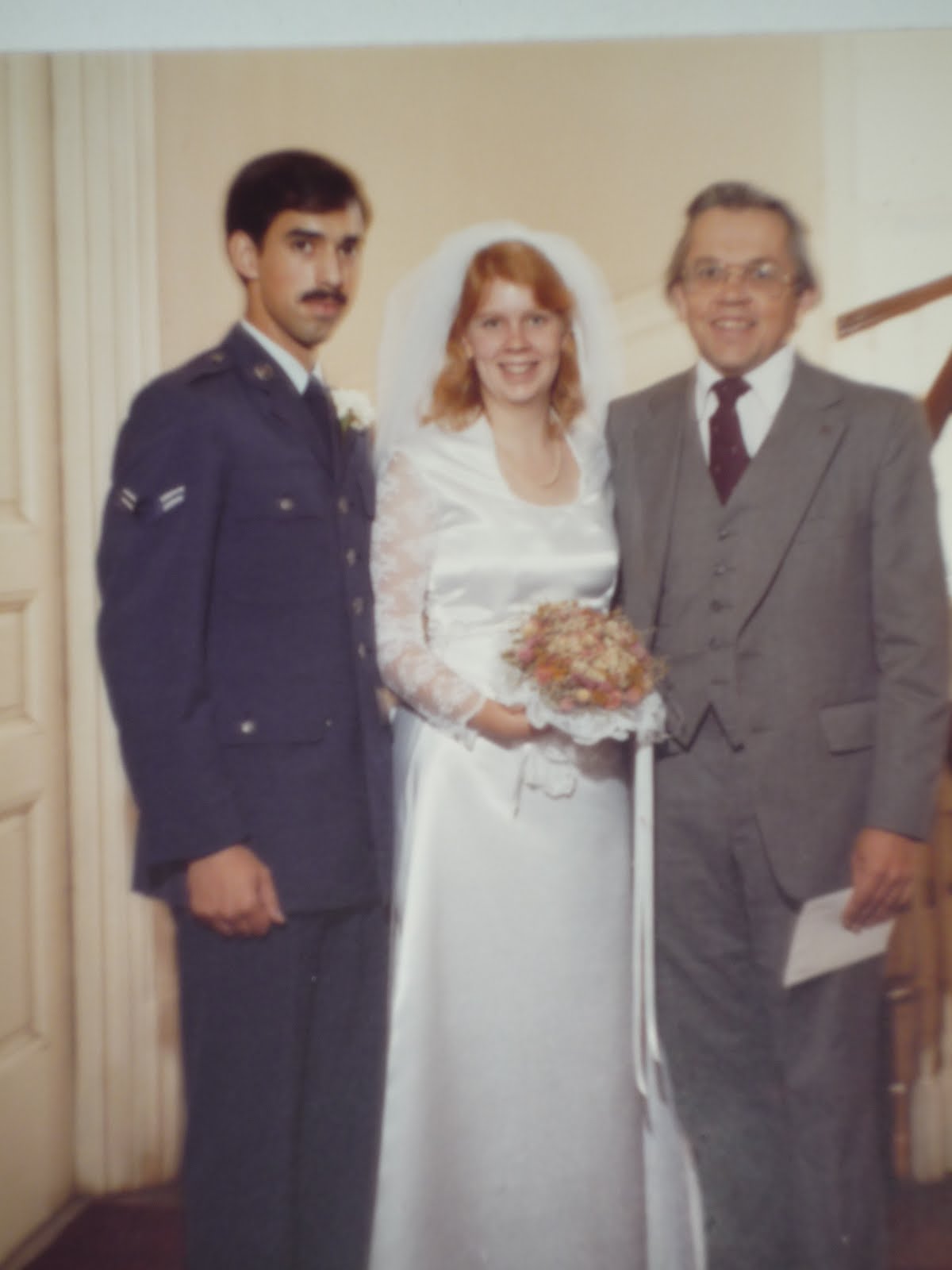
(Airman First Class; USAF Stephen Chrysostom, Jane (West) Chrysostom, Christopher Gist Raible, First Unitarian Church, Worcester Massachusetts, October 24, 1981)
Karin Bach who is originally from Ontario was raised in the Unitarian Church. I'm pleased that Karin met Allyn and Sara this past week. Karin has been operating a unique lodging establishment called An Artist's Garden set in the woods of Albert County along scenic Route 915. She has three self-contained efficiency suites that she designed, built, furnished, and decorated with her uniquely talented eye for taste, color, nature and quality. She recently felled several large trees to give way for the spectacular views of Shepody Bay and Two Rivers Inlet that her secluded property overlooks. My mother would be delighted; Pat frequently advised Karin about the potential of that obstructed view whenever she visited there, but during those earlier years when Karin was getting established with her pottery studio and building a home from the ground up a family was blooming--not easy years, I'd expect, and trees were probably not a priority unless they were already cut down and providing fuel for heat. Karin is an especially hard worker and generous--two qualities my mother highly admired.

(Karin Bach, Patricia Carritt West, Hebron, New Brunswick, Canada)
My mother died in 2002. We remember her in many ways, of course, but Stephen and I established a scholarship in her memory that recalls her good character, dedicated work ethic, and sense of humor through the qualifications of the scholarship recipient. We've awarded six in as many years. I try to imagine my mother reading and selecting qualified applicants, --she was a tough judge of character, and did not suffer fools gladly. I can picture her Dollar-Rama (tm) readers perched on the end of her nose, wearing several layers of wool, lips pursed in concentration, with that light fixture pulled down close to the papers in an otherwise dark house.
Funny how we get to thinking about people, sometimes.
Monday, June 28, 2010
It only hurts when I laugh
We've all been asked the question.
Some of us take no time in coming up with the answer. Some have several choices for their reply. Others have to really think about it, but eventually can find a suitable response. Very few are stumped.
What is your most embarrassing moment?
The question is typically asked in a group setting, usually a party, so you have to choose your response carefully so you don't reveal too much about what causes you embarrassment (it might backfire on you later), or tell something you've done that you might not be proud of, or share part of your character that you might not want people who you're not very well acquainted with to know about you.
I have a few responses, but it's more a list of embarrassing things that I've said than done. And now, faithful blog reader, you're preparing yourself for a humorous accounting of the gaffes, faux pas, blunders, and misspeaks that have rolled off my impetuous tongue in the course of these long years of adulthood.
Not a chance.
I think that inappropriate laughing is a better topic for this blog entry. Really! Think about it. How many times have you been asked the question at a cocktail party?
"When was the worst time that you laughed inappropriately?"
Imagine it, several of you are gathered around someone's living room with a drink, a small napkin with a puff pastry or stuffed mushroom that's too hot to eat--you know it, because the last one you ate scorched the roof of your mouth and you've been nursing it with an ice-cube from your drink for several minutes. People exchange topics about the work that they do, their kids' comings and goings, travels they've made--some guests you may know, some you're just getting acquainted with.
You've probably already pegged some of those who you don't know very well.
Type A: The person who asks you a question, and before you've finished your response, they're answering it for you with the answer that they really wanted to give if you'd asked THEM the question. For example, "Have you ever been to California?" and you respond with "Well, funny you should ask, I've just been a few months ago, and found it to be much colder than I expected for this time of yea...." but they interrupt, and begin to tell you about their experiences in California, and you realize they really didn't care about your answer at all--they just had an agenda to start non-stop talking.
Type B: The person who is everyone's very best friend, and knows everyone else in the room. They find out something about you in some capacity, feign genuine interest in something that you're discussing, and promise you something in the future like:
a follow-up lunch
a book they'll put in the mail about the subject your discussing that they picked up at a yard sale but can't quite finish.
a telephone call with some information that would be pertinent for you to pursue
but you never hear from them again and you realize they are a big phony--so by now you spot them early on.
C: The know-it-all. Enough said. Some esoteric subject has been brought up that piques your interest, and perhaps you know a few facts, but big mouth in the room, knows-it-all. Or does he?
D: Drinky McGluggerton. He's just there for the alcohol; he's actually amusing until he's had too many, at which point he becomes a little grouchy and frumps himself down in the Barcalounger (tm) in the corner and watches everyone else with a combative eye as the evening drags on.
But then the question is popped. Has it ever before? I doubt it. Let's pretend it just has.
"When did you last laugh most inappropriately?"
My mother was a terrible offender. But to her defense, and probably for most of us, an outburst of inappropriate laughter is usually an involuntary expression of stress or relief--(see The Jugular Vein blog entry) --but not always.
When my mother was in a grocery store parking lot one cold wintry day after a freezing rain, she spied a woman who was pushing her heavily laden grocery cart out of the store to her vehicle. The unaware woman hit a patch of ice, and the cart went wayward, while her feet went out from under her causing her to fall to her knees while keeping her grip on the cart. The poor woman slid the entire length of the parking aisle flailing her legs to try regain her footing on the icy-slick pavement, but with no success. By the time the cart came to a stop, and the woman could stand again, with torn stockings and bloodied knees, my mother was hysterical laughing.
Many years ago, we'd gone out to Bennett Lake in Fundy National Park. We had an absolutely gorgeous wooden combination canoe-sail-row boat. The Aphrodite. It was very heavy, but the three of us (I was 13 at the time) could manage it well, and my parents could manage it with a bit of a struggle between the two of them. Wally, would bark commands expecting an immediate and efficient response in action, while unloading the canoe and all its accessories from the top of the car until finally launching it into the water. After several outings, we had a pretty good routine, each of us executing our job with the timely precision of a military mission.
Until one afternoon at the water's edge. We were going sailing. While I was setting the leeboards, Dad was righting the mast, and my mother tied the boom. Something happened at this point, and the boom came down on Dad's head with an audible, and sharp CRACK! Expletives were abundant, and my mother was immediately convulsed with laughter, which elicited even more expletives.
After the tweety-birds stopped circling around Dad's head, we resumed our duties, and Dad returned to the rigging, when
CRACK!
it happened again. Loud. Hard. The angry sailor's vicious vocabulary was considerably more verbose. My mother was unable to catch her breath from uncontrollable laughter. It wasn't that she thought that it was funny, I'm quite sure it just was her coping mechanism.
In our early days of home ownership in Omaha, we had a large Linden tree in the front yard that had several large, broken, and dangerous limbs that needed to be brought down. At the time, we didn't have the standard set of homeowner tools like a tall ladder, a chain saw, or other necessary equipment to do the job safely or properly, but we were concerned that some of the dangling branches might come down and hurt someone. Stephen drove our car up into the yard and stood on the roof to get a better look at them, and indeed, they were precarious limbs.
I advised him to just jump off the roof of the car, grab hold of the branch, and drop down with it as it should easily break off. This was not good advice.
Stephen sprang off the roof of the car with the grace of an Olympic parallel-bar athlete, grabbed the diseased tree branch with both hands and stopped in time and motion for a few seconds when
SNAP!
the branch did break easily, but poor Stephen fell to the ground FAST and landed on his back completely knocking the wind out of him rendering him breathless and dizzy. My immediate response should have been to rush to his side for assistance, but I didn't simply because I became helpless with a fit of manic hysterical laughter that I absolutely could not control. Stephen was not amused.
(Remember when Mary Tyler Moore couldn't help herself at the funeral for Chuckles The Clown? )
Then there was a time when Olivia was in the hospital. It was just one of several lengthy and successive stays when she was most sick several years ago. The nursing staff knew us, and enjoyed Olivia--she was a model patient; she didn't cry, scream, or struggle during painful and invasive treatments, didn't demand toys or television or games, and tolerated the needles better than most adults.
An unfamiliar nurse came into her room one afternoon with a series of hypodermic needles to draw blood, and administer several medications through Olivia's IV. She set the lot of the needles on Olivia's bedside table and turned her back to set up the procedural equipment when Olivia took on of the syringes and inadvertently inserted it directly through her hand---syringe on her palm side, the needle poking out the back of her hand. Olivia calmly looked up at me from her bed and in a quiet monotone voice recognizing trouble held out her hand and said, "mummy?"
I laughed at first, because it was so incredulous that the thoughtless, careless, nurse would leave these syringes within Olivia's reach, and also because it looked so bazaar! This strange anachronism of a small child's hand run through and through with a gleaming hypodermic needle filled with poison. Certainly, not a laughing matter.
I think the next time I'm asked "What was your most embarrassing moment?" I'll return with the question "First, tell me when was the last time you laughed inappropriately?" I think it will be a better conversation.
Either that, or I'll reply, "A little song, a little dance, a little seltzer down your pants." And see what happens.
Some of us take no time in coming up with the answer. Some have several choices for their reply. Others have to really think about it, but eventually can find a suitable response. Very few are stumped.
What is your most embarrassing moment?
The question is typically asked in a group setting, usually a party, so you have to choose your response carefully so you don't reveal too much about what causes you embarrassment (it might backfire on you later), or tell something you've done that you might not be proud of, or share part of your character that you might not want people who you're not very well acquainted with to know about you.
I have a few responses, but it's more a list of embarrassing things that I've said than done. And now, faithful blog reader, you're preparing yourself for a humorous accounting of the gaffes, faux pas, blunders, and misspeaks that have rolled off my impetuous tongue in the course of these long years of adulthood.
Not a chance.
I think that inappropriate laughing is a better topic for this blog entry. Really! Think about it. How many times have you been asked the question at a cocktail party?
"When was the worst time that you laughed inappropriately?"
Imagine it, several of you are gathered around someone's living room with a drink, a small napkin with a puff pastry or stuffed mushroom that's too hot to eat--you know it, because the last one you ate scorched the roof of your mouth and you've been nursing it with an ice-cube from your drink for several minutes. People exchange topics about the work that they do, their kids' comings and goings, travels they've made--some guests you may know, some you're just getting acquainted with.
You've probably already pegged some of those who you don't know very well.
Type A: The person who asks you a question, and before you've finished your response, they're answering it for you with the answer that they really wanted to give if you'd asked THEM the question. For example, "Have you ever been to California?" and you respond with "Well, funny you should ask, I've just been a few months ago, and found it to be much colder than I expected for this time of yea...." but they interrupt, and begin to tell you about their experiences in California, and you realize they really didn't care about your answer at all--they just had an agenda to start non-stop talking.
Type B: The person who is everyone's very best friend, and knows everyone else in the room. They find out something about you in some capacity, feign genuine interest in something that you're discussing, and promise you something in the future like:
a follow-up lunch
a book they'll put in the mail about the subject your discussing that they picked up at a yard sale but can't quite finish.
a telephone call with some information that would be pertinent for you to pursue
but you never hear from them again and you realize they are a big phony--so by now you spot them early on.
C: The know-it-all. Enough said. Some esoteric subject has been brought up that piques your interest, and perhaps you know a few facts, but big mouth in the room, knows-it-all. Or does he?
D: Drinky McGluggerton. He's just there for the alcohol; he's actually amusing until he's had too many, at which point he becomes a little grouchy and frumps himself down in the Barcalounger (tm) in the corner and watches everyone else with a combative eye as the evening drags on.
But then the question is popped. Has it ever before? I doubt it. Let's pretend it just has.
"When did you last laugh most inappropriately?"
My mother was a terrible offender. But to her defense, and probably for most of us, an outburst of inappropriate laughter is usually an involuntary expression of stress or relief--(see The Jugular Vein blog entry) --but not always.
When my mother was in a grocery store parking lot one cold wintry day after a freezing rain, she spied a woman who was pushing her heavily laden grocery cart out of the store to her vehicle. The unaware woman hit a patch of ice, and the cart went wayward, while her feet went out from under her causing her to fall to her knees while keeping her grip on the cart. The poor woman slid the entire length of the parking aisle flailing her legs to try regain her footing on the icy-slick pavement, but with no success. By the time the cart came to a stop, and the woman could stand again, with torn stockings and bloodied knees, my mother was hysterical laughing.
Many years ago, we'd gone out to Bennett Lake in Fundy National Park. We had an absolutely gorgeous wooden combination canoe-sail-row boat. The Aphrodite. It was very heavy, but the three of us (I was 13 at the time) could manage it well, and my parents could manage it with a bit of a struggle between the two of them. Wally, would bark commands expecting an immediate and efficient response in action, while unloading the canoe and all its accessories from the top of the car until finally launching it into the water. After several outings, we had a pretty good routine, each of us executing our job with the timely precision of a military mission.
Until one afternoon at the water's edge. We were going sailing. While I was setting the leeboards, Dad was righting the mast, and my mother tied the boom. Something happened at this point, and the boom came down on Dad's head with an audible, and sharp CRACK! Expletives were abundant, and my mother was immediately convulsed with laughter, which elicited even more expletives.
After the tweety-birds stopped circling around Dad's head, we resumed our duties, and Dad returned to the rigging, when
CRACK!
it happened again. Loud. Hard. The angry sailor's vicious vocabulary was considerably more verbose. My mother was unable to catch her breath from uncontrollable laughter. It wasn't that she thought that it was funny, I'm quite sure it just was her coping mechanism.
In our early days of home ownership in Omaha, we had a large Linden tree in the front yard that had several large, broken, and dangerous limbs that needed to be brought down. At the time, we didn't have the standard set of homeowner tools like a tall ladder, a chain saw, or other necessary equipment to do the job safely or properly, but we were concerned that some of the dangling branches might come down and hurt someone. Stephen drove our car up into the yard and stood on the roof to get a better look at them, and indeed, they were precarious limbs.
I advised him to just jump off the roof of the car, grab hold of the branch, and drop down with it as it should easily break off. This was not good advice.
Stephen sprang off the roof of the car with the grace of an Olympic parallel-bar athlete, grabbed the diseased tree branch with both hands and stopped in time and motion for a few seconds when
SNAP!
the branch did break easily, but poor Stephen fell to the ground FAST and landed on his back completely knocking the wind out of him rendering him breathless and dizzy. My immediate response should have been to rush to his side for assistance, but I didn't simply because I became helpless with a fit of manic hysterical laughter that I absolutely could not control. Stephen was not amused.
(Remember when Mary Tyler Moore couldn't help herself at the funeral for Chuckles The Clown? )
Then there was a time when Olivia was in the hospital. It was just one of several lengthy and successive stays when she was most sick several years ago. The nursing staff knew us, and enjoyed Olivia--she was a model patient; she didn't cry, scream, or struggle during painful and invasive treatments, didn't demand toys or television or games, and tolerated the needles better than most adults.
An unfamiliar nurse came into her room one afternoon with a series of hypodermic needles to draw blood, and administer several medications through Olivia's IV. She set the lot of the needles on Olivia's bedside table and turned her back to set up the procedural equipment when Olivia took on of the syringes and inadvertently inserted it directly through her hand---syringe on her palm side, the needle poking out the back of her hand. Olivia calmly looked up at me from her bed and in a quiet monotone voice recognizing trouble held out her hand and said, "mummy?"
I laughed at first, because it was so incredulous that the thoughtless, careless, nurse would leave these syringes within Olivia's reach, and also because it looked so bazaar! This strange anachronism of a small child's hand run through and through with a gleaming hypodermic needle filled with poison. Certainly, not a laughing matter.
I think the next time I'm asked "What was your most embarrassing moment?" I'll return with the question "First, tell me when was the last time you laughed inappropriately?" I think it will be a better conversation.
Either that, or I'll reply, "A little song, a little dance, a little seltzer down your pants." And see what happens.
Subscribe to:
Posts (Atom)


 Posts
Posts

